







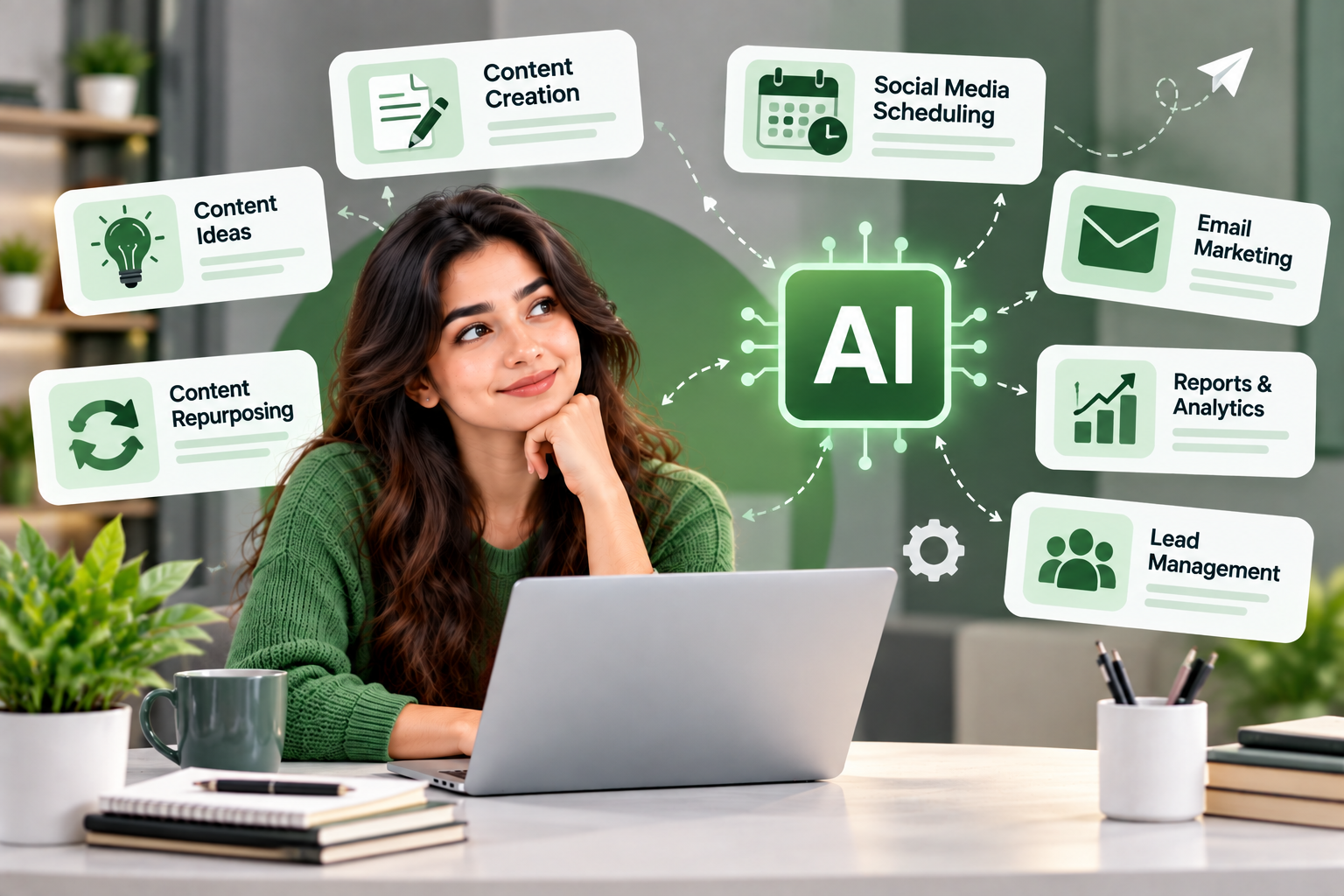
Marketing involves plenty of creative work, but it also includes many repetitive tasks that can consume hours every week. Scheduling posts, organising content ideas, writing basic email drafts, analysing reports and creating campaign variations are all important, but they do not always require the same level of human attention.
This is where you can automate marketing tasks with AI.
AI tools can help marketers handle repetitive processes faster while leaving more time for strategy, creativity and customer-focused work. The goal is not to remove humans from marketing. It is to let AI handle predictable tasks while people focus on decisions that require experience and judgement.
What Are Repetitive Marketing Tasks?
Repetitive marketing tasks are activities that follow similar steps each time they are performed.
Common examples include:
- Scheduling social media posts
- Creating content ideas
- Drafting basic emails
- Summarising campaign reports
- Organising leads
- Creating content variations
- Generating marketing briefs
- Analysing customer feedback
- Repurposing existing content
- Preparing weekly reports
These tasks can add up quickly.
A marketer may spend a few minutes on one task, but repeating that task dozens or hundreds of times can take a significant amount of working time.
AI can help reduce that repetitive workload.
1. Automate Social Media Content Ideas
Coming up with social media ideas every day can become repetitive.
AI can help generate topic ideas based on:
- Your industry
- Target audience
- Products
- Services
- Seasonal events
- Frequently asked questions
- Previous content performance
For example, a marketing agency could provide AI with its main services and target audience and ask for 30 social media ideas for the upcoming month.
The marketer can then select the useful ideas, adjust them and turn them into actual content.
The important part is not publishing every AI-generated idea.
Use AI for brainstorming, then apply human judgement.
2. Automate Content Repurposing
You do not always need to create new content from scratch.
One detailed blog post can become:
- Instagram captions
- LinkedIn posts
- Email content
- Short video scripts
- Carousel ideas
- FAQ content
- Short-form posts
AI can help convert existing content into these different formats.
For example, after publishing a detailed article, you can provide the content to an AI tool and ask it to identify five important points that could become social media posts.
This saves time while allowing you to get more value from content you have already created.
3. Automate Basic Email Drafts
Email marketing often involves repeating similar types of communication.
AI can help create first drafts for:
- Welcome emails
- Follow-ups
- Product announcements
- Event reminders
- Newsletter sections
- Customer updates
- Re-engagement campaigns
Instead of starting with a blank page, marketers can provide the basic information and let AI create an initial draft.
The marketer can then check the message, adjust the tone, add brand-specific details and approve the final version.
This approach is usually more useful than allowing AI to send messages without review.
4. Turn Customer Questions Into Content Ideas
Your customers are already telling you what they want to know.
Questions from:
- Emails
- Social media comments
- Customer support
- Sales calls
- Reviews
- Website forms
can become valuable content ideas.
AI can help organise these questions into themes.
For example, if customers repeatedly ask:
“How long does delivery take?”
“Which product should I choose?”
“How do I use this service?”
AI can group similar questions and suggest content topics around them.
This creates a more customer-focused content strategy.
5. Automate Marketing Report Summaries
Marketing platforms can generate large amounts of data.
You may need to review:
- Website traffic
- Conversion rates
- Ad performance
- Click-through rates
- Engagement
- Leads
- Email performance
Instead of manually reading every number, AI can help summarise the data.
For example, you can use AI to identify:
What improved?
What declined?
Which campaign performed differently?
What needs further investigation?
The final decisions should still come from the marketing team.
AI can summarise the information, but numbers need context.
6. Create Multiple Ad Variations
Testing different marketing messages is important, but creating dozens of variations manually can take time.
AI can help generate different versions of:
- Headlines
- Ad copy
- Calls to action
- Product descriptions
- Short promotional messages
For example, one product benefit could be turned into five different headline styles:
Problem-focused
Benefit-focused
Question-based
Short and direct
Curiosity-driven
A marketer can then choose which versions are appropriate for testing.
7. Automate Basic Lead Organisation
Marketing teams often receive leads from different sources.
These may come from:
- Website forms
- Social media
- Advertisements
- Emails
- Landing pages
AI-powered systems can help categorise leads based on information provided by the customer.
For example:
High interest
Needs follow-up
Existing customer
General enquiry
Not currently ready
This can help teams spend less time manually sorting information.
However, automated classifications should be reviewed when the decision has significant business consequences.
8. Automate Review and Feedback Analysis
Customer reviews contain valuable information, but reading hundreds of reviews manually can be difficult.
AI can help identify recurring themes.
For example, a business could analyse reviews and discover that customers frequently mention:
- Fast delivery
- Product quality
- Difficult checkout
- Slow customer support
- Easy installation
Instead of simply collecting reviews, the business can use these patterns to identify areas for improvement.
This turns customer feedback into actionable marketing information.
9. Create Marketing Briefs Faster
Before starting a campaign, marketers often prepare a brief containing:
- Campaign objective
- Target audience
- Key message
- Content formats
- Platforms
- Deadlines
- Call to action
AI can create a first draft of this brief from a few basic details.
The marketing team can then refine it.
This can reduce the time spent repeatedly formatting similar campaign documents.
10. Automate Weekly Marketing Summaries
A weekly marketing summary can include:
- Major campaigns completed
- Content published
- Leads generated
- Website performance
- Social media performance
- Advertising results
- Important observations
AI can help turn raw information into a structured summary.
For example:
This week’s highlights
Areas that need attention
Campaign performance
Next steps
This makes recurring reporting much faster.
11. Use AI to Create Content Briefs
Before writing an article, marketers can ask AI to help organise:
- Main topic
- Search intent
- Potential subtopics
- Questions
- Content structure
- Related concepts
This can reduce the time needed to build an initial outline.
However, the final brief should be reviewed to make sure it reflects the actual audience and brand strategy.
12. Automate Repetitive Data Entry
Marketing information often needs to be moved between different systems.
For example:
Form submission ? Lead database ? CRM ? Follow-up task
Automation tools combined with AI can help reduce manual data entry.
This is particularly useful when the same information is processed repeatedly.
The less time marketers spend copying and pasting information, the more time they have for creative and strategic work.
13. Build Simple AI Workflows
Instead of using AI for individual tasks, businesses can connect several tasks together.
For example:
Customer question received
?
AI categorises the question
?
Related content identified
?
Potential response drafted
?
Team reviews response
?
Final response sent
This is an example of a simple AI-assisted workflow.
The important point is that automation does not need to be complicated.
Start with one repetitive process.
Improve it.
Then connect it to another process.
14. Don’t Automate Everything
Automation is useful, but not every marketing task should be automated.
Some activities require human judgement.
These include:
- Brand positioning
- Sensitive customer communication
- Major campaign decisions
- Crisis communication
- Creative direction
- Important pricing decisions
- Brand reputation management
If a task involves emotion, reputation or significant business consequences, human review becomes especially important.
15. Always Review AI-Generated Marketing Content
AI can make mistakes.
It may:
- Misunderstand instructions
- Create inaccurate information
- Use the wrong tone
- Repeat ideas
- Make unsupported claims
- Miss important context
For this reason, AI-generated marketing content should not automatically go live.
Use a simple workflow:
AI creates ? Human reviews ? Human edits ? Final approval ? Publish
This creates a balance between speed and quality.
A Simple AI Marketing Automation Workflow
If you are new to AI automation, start with a simple system.
Step 1: Identify One Repetitive Task
Choose something you perform regularly.
For example:
Weekly social media idea generation
Step 2: Document the Current Process
Write down how you currently complete the task.
Step 3: Identify What AI Can Handle
Find the parts that are repetitive and predictable.
Step 4: Create an AI Prompt or Workflow
Give the AI clear instructions, examples and expected output.
Step 5: Add Human Review
Check the output before it reaches customers.
Step 6: Measure the Time Saved
Compare how long the task took before and after automation.
Step 7: Improve the Workflow
Once the process works reliably, look for another repetitive task to automate.
Common Mistakes When Automating Marketing With AI
Automating Too Much Too Quickly
Start with one process rather than trying to automate the entire marketing department.
Giving AI Vague Instructions
Clear inputs usually produce more useful outputs.
Skipping Human Review
Automation should not mean abandoning quality control.
Focusing Only on Speed
Saving time is useful, but the final marketing output still needs to be valuable.
Using the Same Workflow for Every Brand
Different audiences and businesses require different strategies.
Ignoring Data Privacy
Be careful when entering customer information, confidential business information or sensitive data into AI systems.
How to Decide What to Automate First
A simple rule is to look for tasks that are:
Frequent + Repetitive + Predictable + Time-consuming
For example:
| Task | Frequency | Automation Potential |
|---|---|---|
| Weekly report summary | High | High |
| Content idea generation | High | High |
| Data entry | High | High |
| Social media repurposing | Medium | High |
| Brand strategy | Low | Low |
| Crisis communication | Low | Low |
| Creative direction | Medium | Medium |
This helps you focus automation efforts where they are most useful.
Final Thoughts
AI marketing automation is not about replacing marketers.
It is about removing unnecessary repetitive work so marketers can spend more time on strategy, creativity and customers.
Start small.
Choose one repetitive task.
Build a simple workflow.
Review the results.
Then expand gradually.
The most effective AI marketing systems are not necessarily the most complicated ones. They are the systems that solve real problems while keeping people involved where human judgement matters most.
Frequently Asked Questions
What marketing tasks can AI automate?
AI can assist with content ideas, content repurposing, email drafts, report summaries, customer feedback analysis, lead categorisation, campaign variations and other repetitive processes.
Is AI marketing automation suitable for small businesses?
Yes. Small businesses can use AI to reduce repetitive work without needing a large marketing team. The best starting point is usually one simple, recurring task.
Can AI completely automate marketing?
Some processes can be highly automated, but marketing still requires human strategy, creativity, judgement and oversight.
How do I start automating my marketing?
Identify one repetitive task, document the current process, determine which parts AI can handle, create a workflow, and add human review before the output reaches customers.
Is AI-generated marketing content ready to publish?
Not always. AI-generated content should be reviewed for accuracy, tone, brand consistency and relevance before publication.
What is the biggest benefit of AI marketing automation?
One major benefit is reducing the amount of time marketers spend on repetitive work, allowing them to focus more on strategic and creative activities.



















Mình v?a tham kh?o qua https://fly88.co.com/, th?y thông tin khá ??y ??.