




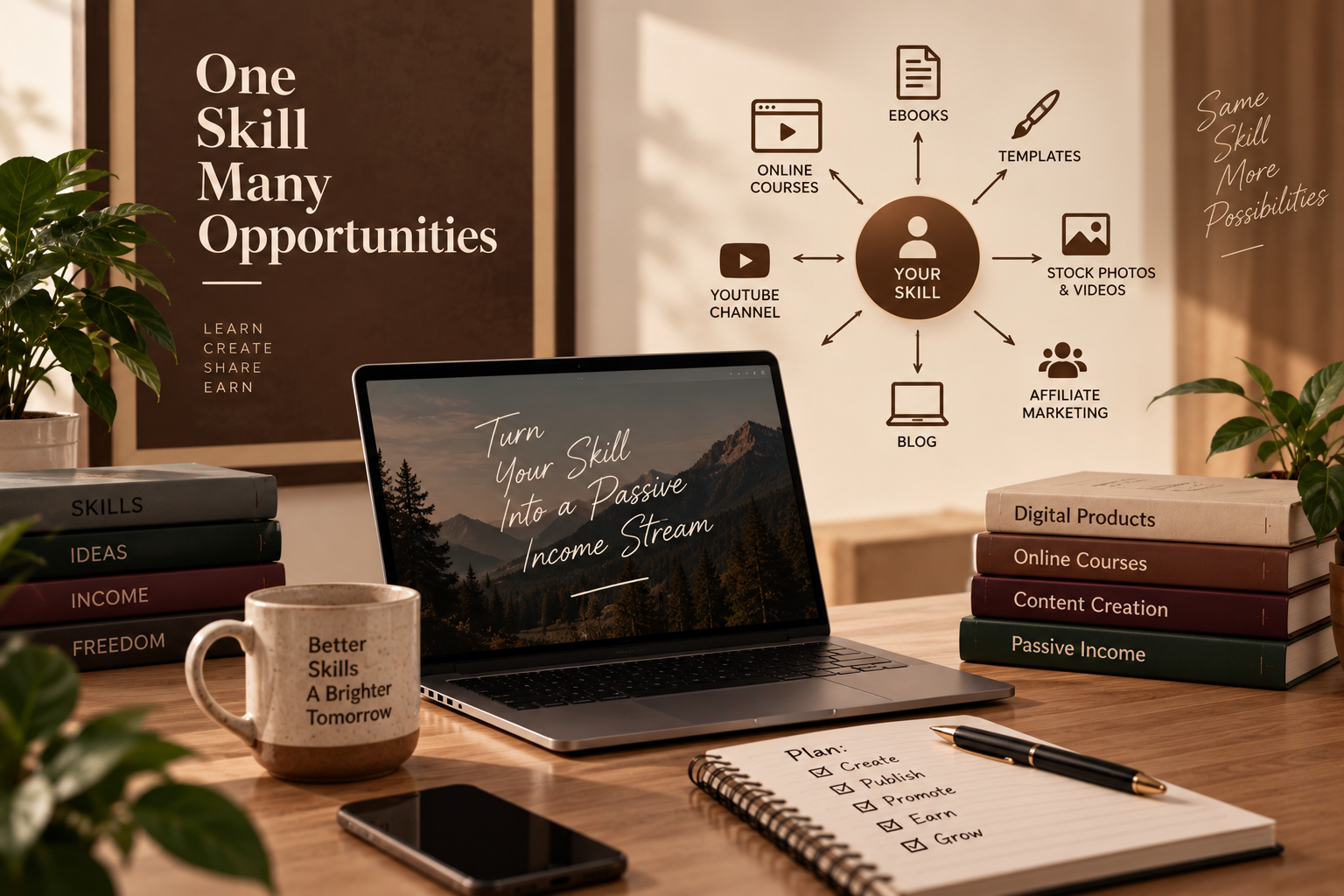
You do not always need several businesses or multiple skills to start building an online income stream. One useful skill can become the foundation for passive income from one skill when you turn your knowledge or ability into products, content, or systems that can continue generating revenue after the initial work is completed.
For example, if you know graphic design, you could create templates. If you understand SEO, you could create an SEO guide or course. If you are good at photography, you could sell stock images. If you understand social media marketing, you could create resources that help businesses manage their content.
The key idea is simple:
Do not sell your time every time you want to earn money. Turn what you know into something that can be sold or discovered repeatedly.
That does not mean passive income requires no work. Most passive or semi-passive income streams require significant effort upfront, along with occasional updates, marketing, customer support, and maintenance.
Here is how you can build one using a skill you already have.
What Does Passive Income From One Skill Mean
Passive income from one skill means creating an income-generating asset based on a skill you already possess.
Instead of only getting paid when you personally complete a task, you create something that can potentially generate income multiple times.
For example:
Graphic designer ? Canva templates ? digital product sales
Writer ? ebook ? repeated sales
SEO specialist ? SEO course ? course sales
Photographer ? stock photos ? licensing income
Video editor ? editing templates ? digital downloads
Marketer ? marketing resources ? product or affiliate income
Your skill is the starting point.
The goal is to turn that skill into an asset.
Why One Skill Can Be Enough
Many people think they need to learn everything before starting an online business.
They try to learn:
- Graphic design
- Website development
- SEO
- Video editing
- Copywriting
- Advertising
- Social media
- Sales
This can quickly become overwhelming.
You do not necessarily need to become an expert in everything.
Start with one skill that you already understand reasonably well.
Then learn only the additional skills required to package, market, and sell your knowledge.
For example, a graphic designer does not need to become an advanced programmer to sell digital templates.
They may only need to learn:
- Product creation
- Basic marketing
- Online selling
- Customer communication
- Simple analytics
This makes the process more manageable.
Step 1 Find Your Most Valuable Skill
Start by making a list of skills you already have.
These could be professional skills, hobbies, or things you have learned through experience.
Examples include:
- Graphic design
- Writing
- Photography
- Video editing
- Coding
- Web design
- SEO
- Social media management
- Teaching
- Illustration
- Marketing
- Excel
- Presentation design
- Language skills
- Research
- Productivity
- Fitness knowledge
Now ask:
Which skill can solve a specific problem for another person?
That question is more important than simply asking what you are good at.
A skill becomes easier to monetize when it solves a problem.
Step 2 Identify a Problem Your Skill Can Solve
Do not start by asking:
“What can I sell?”
Start with:
“What problem can I solve?”
For example, if you know graphic design, people may struggle with:
- Creating social media posts
- Designing presentations
- Making business flyers
- Creating resumes
- Building brand materials
If you know SEO, people may struggle with:
- Finding keywords
- Planning blog content
- Improving website visibility
- Creating internal links
- Understanding search intent
Your product should make one of these problems easier.
Step 3 Choose a Passive or Semi-Passive Income Model
Your skill can potentially be converted into several different income models.
Digital Products
You can create:
- Templates
- Checklists
- Guides
- Workbooks
- Presets
- Spreadsheets
- Design resources
- Prompt packs
- Planning documents
Digital products are attractive because you can create them once and potentially sell them multiple times.
Online Courses
If your skill can be taught step by step, a course may be an option.
For example:
Skill: Video editing
Product: Beginner video editing course
The course requires significant work to create, but students can access the material repeatedly.
Ebooks
You can organize your knowledge into a focused ebook.
For example:
Skill: Social media marketing
Product: Beginner’s guide to social media content planning
A useful ebook should solve a specific problem rather than simply contain general information.
Affiliate Marketing
If you have knowledge about a particular topic, you can create useful content around tools or products related to that skill.
You may then earn a commission when readers purchase through eligible affiliate links.
For example:
Skill: Graphic design
You could create tutorials about design tools and recommend relevant software through affiliate programs where available.
Content
You can use your skill to create:
- Blog posts
- YouTube videos
- Tutorials
- Social media content
- Newsletters
Content can attract an audience over time and create opportunities for advertising, affiliate marketing, sponsorships, or your own products.
Step 4 Turn Your Skill Into a Product
This is where your skill starts becoming an asset.
Suppose you are good at social media design.
Instead of only offering:
“I will design 10 Instagram posts for you.”
you could also create:
“50 Editable Instagram Templates for Small Businesses.”
The first option mainly sells your time.
The second creates a reusable product.
You can still provide custom services, but the digital product gives you another way to earn from the same knowledge.
Step 5 Start With One Small Product
Do not spend six months creating a massive product before finding out whether anyone wants it.
Start small.
For example:
- 20 social media templates
- A short SEO checklist
- A beginner’s ebook
- A spreadsheet template
- A simple video editing preset pack
- A one-hour mini-course
- A content calendar
The goal is to solve one clear problem.
You can improve the product after receiving feedback.
Step 6 Make Your Product Easy to Use
A product can contain excellent information and still fail if customers find it difficult to use.
Make your product:
- Clear
- Organized
- Beginner-friendly
- Easy to download
- Easy to understand
- Visually clean
- Focused on one outcome
If you create a template, include simple instructions.
If you create a guide, organize it into steps.
If you create a course, structure the lessons logically.
The easier your product is to use, the more useful it becomes.
Step 7 Create a Simple Sales Page
You do not need a complicated website to start.
A basic sales page should explain:
What Is the Product?
Clearly describe what the customer receives.
Who Is It For?
Tell visitors who will benefit from it.
What Problem Does It Solve?
Explain the problem rather than only listing features.
What Is Included?
Show exactly what buyers receive.
Why Should They Trust You?
Include relevant experience, examples, testimonials, or demonstrations where appropriate.
What Does It Cost?
Make pricing easy to understand.
Your sales page should answer the customer’s main questions before they buy.
Step 8 Use Content to Bring People to Your Product
A product cannot generate sales if nobody discovers it.
This is where content becomes useful.
For example, if you sell SEO templates, you could publish content about:
- SEO basics
- Keyword research
- Content planning
- Internal linking
- Search intent
Each useful piece of content can introduce people to your expertise.
You can then naturally mention your relevant product when it genuinely helps the reader.
This creates a simple system:
Helpful content ? Audience ? Product ? Sale
Step 9 Build an Email List
Social media platforms can help you reach people, but you do not completely control those platforms.
Building an email list gives you a direct communication channel with people who choose to hear from you.
You could offer a useful free resource such as:
- Checklist
- Mini guide
- Template
- Cheat sheet
- Short email course
In exchange, visitors can subscribe to your newsletter.
Later, you can send:
- Helpful tips
- New content
- Product updates
- Tutorials
- Relevant offers
Avoid sending constant promotional messages.
The goal is to build trust, not simply send sales emails.
Step 10 Use AI to Speed Up the Process
AI can help you build a passive-income system faster, but it should support your expertise rather than replace it.
You can use AI for:
- Product ideas
- Content outlines
- Research organization
- Drafting descriptions
- Email ideas
- Social media ideas
- Customer FAQ drafts
- Content repurposing
- Data analysis
For example, a graphic designer could use AI to brainstorm 50 template ideas and then use their own design experience to create the actual products.
The value still comes from your judgment and expertise.
Step 11 Automate Repetitive Tasks
Once you start getting customers, look for tasks that can be automated.
For example:
Customer discovers product ? Visits sales page ? Purchases ? Receives download ? Gets confirmation email
This type of workflow can reduce the amount of manual work required.
You may also automate:
- Email delivery
- Purchase confirmations
- Basic customer onboarding
- Appointment reminders
- Content scheduling
- Product delivery
Automation does not make the business completely passive, but it can make it more efficient.
Step 12 Improve Your Product Based on Feedback
Your first product does not need to be perfect.
Pay attention to customer questions.
If several customers ask the same question, improve the instructions.
If people struggle with a particular section, simplify it.
If customers request another format, consider adding it.
Over time, your product can become more valuable without requiring you to rebuild everything from scratch.
Examples of Turning One Skill Into Passive Income
Here are some simple examples.
Graphic Designer
Skill ? Templates ? Digital product sales
You could create:
- Instagram templates
- Business card templates
- Presentation templates
- Resume templates
Writer
Skill ? Ebook ? Repeated sales
You could create a focused guide around a subject you understand well.
SEO Specialist
Skill ? SEO resources ? Digital products
You could create:
- SEO checklists
- Keyword research templates
- Content calendars
- SEO worksheets
Photographer
Skill ? Stock content ? Licensing
You could upload suitable images or video footage to platforms that license creative assets.
Teacher
Skill ? Course ? Course sales
You could package your knowledge into structured lessons.
Video Editor
Skill ? Editing assets ? Digital downloads
You could create:
- Video templates
- Presets
- Motion graphics resources
- Editing checklists
The specific income potential depends on factors such as demand, product quality, pricing, marketing, competition, and audience size.
How Much Can One Skill Earn
There is no guaranteed income level.
Your results may depend on:
- Demand for the skill
- Quality of the product
- Audience size
- Marketing ability
- Competition
- Pricing
- Distribution
- Customer trust
- Consistency
For example, imagine you create a digital product priced at ?499.
If 20 people purchase it:
?499 × 20 = ?9,980
If 100 people purchase it:
?499 × 100 = ?49,900
These are simple revenue examples, not guaranteed earnings. Platform fees, taxes, refunds, advertising costs, and other expenses can reduce the actual amount you keep.
The bigger lesson is that one product can potentially be sold more than once without you recreating it for every customer.
Passive Income Does Not Mean Zero Work
This is one of the biggest misconceptions about passive income.
You may still need to:
- Update products
- Answer customer questions
- Fix problems
- Create new content
- Market your products
- Monitor sales
- Update links
- Improve your website
- Respond to changing customer needs
The difference is that your income is not always directly tied to every hour you work.
A better way to think about it is:
Do the work once, create an asset, then maintain and improve that asset over time.
Common Mistakes to Avoid
Trying to Monetize Every Skill
You do not need five income streams immediately.
Start with one.
Creating a Product Nobody Needs
Always validate the problem before investing significant time.
Making the Product Too Broad
A product designed for everyone may not feel useful to anyone.
Choose a specific audience.
Ignoring Marketing
A great product can still struggle if nobody knows it exists.
Expecting Immediate Passive Income
Building an asset takes time.
Copying Other Creators
Study the market, but create something based on your own knowledge and perspective.
Forgetting About Maintenance
Products, platforms, links, and information can become outdated.
Review your assets periodically.
A Simple 30-Day Plan
You can start with a small project rather than trying to build an entire business.
Week 1 Research
Choose one skill.
Identify a specific problem.
Research what your target audience needs.
Look at existing solutions and identify gaps.
Week 2 Create
Build your first small digital product.
Keep it focused.
Make it easy to use.
Week 3 Launch
Create a simple sales page.
Set up payment and delivery.
Publish helpful content related to the problem you solve.
Week 4 Improve
Collect feedback.
Track visitors and sales.
Improve the product and sales page.
Create additional content.
At the end of 30 days, you may not have a large passive-income business, but you can have something more valuable:
Your first income-generating digital asset.
How to Build Multiple Income Streams From the Same Skill
Once one system starts working, you can expand without learning an entirely new skill.
For example:
One skill ? One product ? More products ? Content ? Affiliate income ? Course ? Email audience
Suppose your skill is SEO.
You could eventually create:
- SEO checklist
- Keyword research template
- SEO ebook
- SEO course
- SEO blog
- Affiliate recommendations
- Paid newsletter
All of these can be connected to the same area of expertise.
This is often more efficient than constantly jumping between unrelated side hustles.
Final Thoughts
Building passive income from one skill is less about finding a magical income method and more about turning your existing knowledge into an asset.
Start with one skill.
Find one real problem.
Create one useful product.
Build a simple system to sell and deliver it.
Then improve that system over time.
You do not need to build everything at once.
A single skill can become the foundation for digital products, courses, content, affiliate marketing, or other income opportunities.
The important thing is to focus on creating something genuinely useful and give it enough time to find the right audience.
Frequently Asked Questions
Can one skill really create passive income?
Yes, one skill can potentially be turned into digital products, courses, content, affiliate opportunities, or other assets that may generate income repeatedly. However, income is not guaranteed and most systems require ongoing maintenance and marketing.
What is the easiest skill to turn into passive income?
There is no single easiest skill for everyone. Skills such as writing, design, teaching, photography, coding, SEO, and marketing can all be packaged into products or educational resources.
Do I need money to start?
Some methods can be started with very little money, especially if you already have the necessary skills and tools. However, you may eventually have costs for websites, software, payment processing, advertising, or other services.
How long does it take to build passive income?
There is no fixed timeline. It depends on the product, audience, demand, marketing, competition, and consistency. Building a useful income-generating asset usually takes time.
Can AI help me build passive income?
AI can help with research, brainstorming, content creation, product planning, marketing, and repetitive tasks. Your own expertise and quality control remain important.
Is passive income completely passive?
Usually not. Most passive or semi-passive income streams require upfront work and ongoing maintenance, customer support, marketing, and updates.
Should I create multiple passive income streams?
It can make sense to expand after you have developed one working system. Starting with one skill and one income model can be easier to manage than launching several unrelated projects at once.