




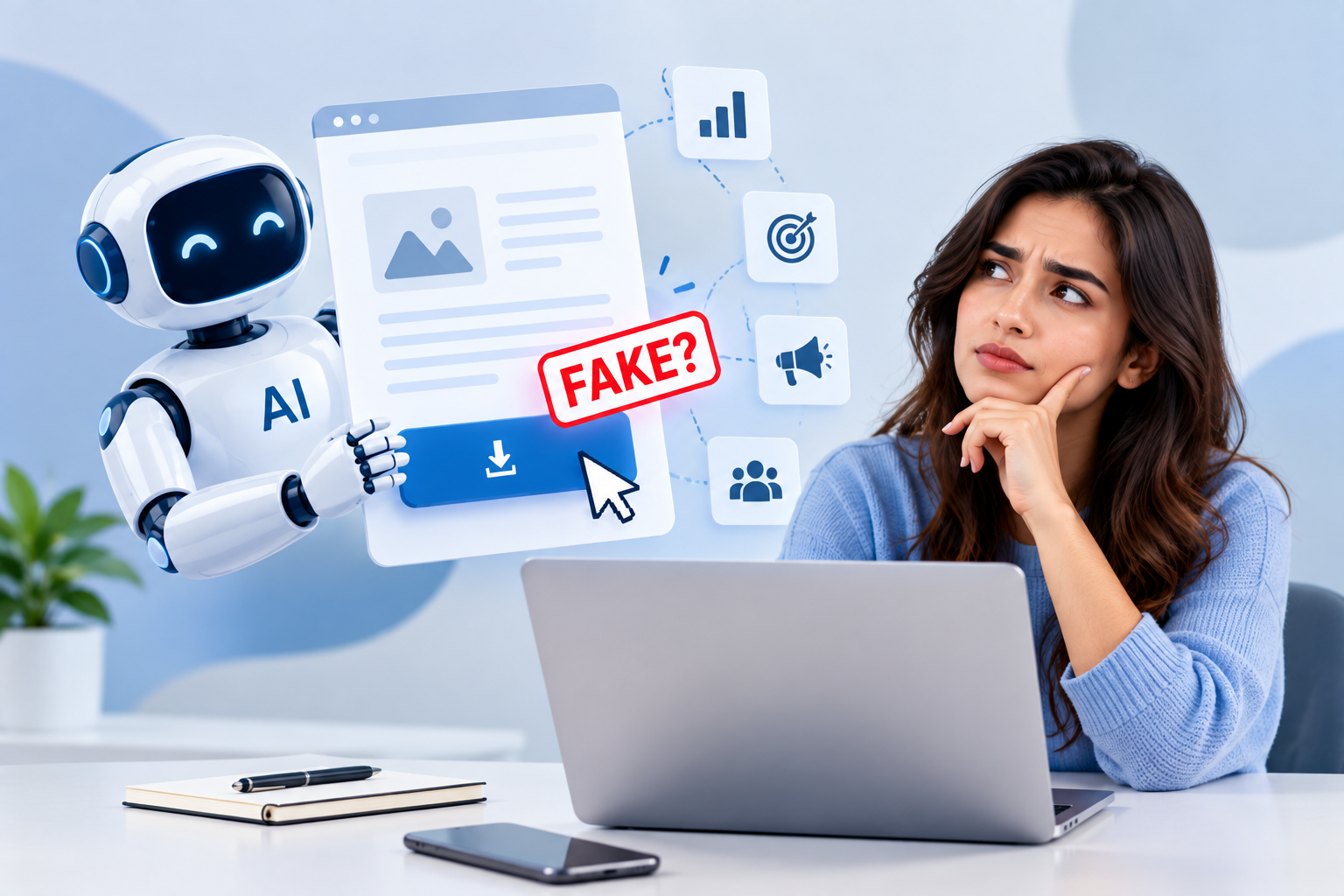
AI marketing mistakes can make even a professional brand feel robotic, repetitive, or strangely disconnected from its audience. AI can help businesses create content, analyse data, generate ideas, personalise campaigns, and automate repetitive marketing tasks. But using AI everywhere without a clear strategy can create a different problem — your marketing may start looking like it was produced by a machine instead of a real brand.
Customers notice when every caption sounds the same.
They notice when product descriptions feel generic.
They notice when a brand publishes huge amounts of content without saying anything useful.
The solution is not to stop using AI. Instead, businesses need to understand where AI helps and where human judgement still matters.
Here are seven common AI marketing mistakes that can make your brand look less authentic.
1. Publishing AI Content Without Editing It
One of the biggest mistakes is treating the first AI-generated draft as the final version.
AI can produce a complete article, caption, email, or product description within seconds. But fast content is not automatically good content.
AI-generated writing can sometimes contain:
- Repetitive phrases
- Generic statements
- Unnecessary introductions
- Incorrect information
- Unnatural wording
- Similar sentence structures
- Claims without proper context
For example, imagine every social media caption from a brand starts with phrases like:
“In today’s fast-paced world…”
or:
“It’s time to unlock your potential…”
After seeing this repeatedly, customers may start feeling that the brand is using automated content instead of communicating naturally.
What to do instead
Use AI as a starting point.
Then add:
- Your own examples
- Brand-specific information
- Real customer questions
- Personal insights
- Industry experience
- A natural writing style
AI can create the draft.
Your brand should create the personality.
2. Using the Same AI Tone Everywhere
Different brands should sound different.
A luxury jewellery brand, cybersecurity company, children’s education platform, and local restaurant should not all communicate in exactly the same way.
Yet this can happen when marketers rely heavily on default AI writing styles.
The result is content that sounds polished but interchangeable.
Your audience should be able to recognise your brand even without seeing the logo.
Build a clear brand voice
Decide whether your brand should sound:
- Friendly
- Professional
- Playful
- Educational
- Bold
- Minimal
- Conversational
- Premium
Then train your AI workflow around that voice.
Also give the AI real examples of your existing communication style.
The goal is not simply to make AI write better.
It is to make AI write like your brand.
3. Creating Too Much Content
AI makes content production extremely easy.
That can become a problem.
A business that previously published two useful articles a month may suddenly start publishing twenty.
But more content does not automatically mean better marketing.
If most of those articles provide little original information, your website can become filled with repetitive pages that offer little value to readers.
The same problem can happen on social media.
Posting five times a day is not useful if every post says almost the same thing.
Focus on usefulness
Before creating another piece of content, ask:
Does this answer a real customer question?
Does it provide something new?
Does it help someone make a decision?
Does it support the brand’s goals?
If the answer is no, you may not need another piece of content.
4. Using AI-Generated Images That Don’t Match Your Brand
AI image generation can create impressive visuals quickly.
But random AI images can make a brand look inconsistent.
Imagine a business using:
- A realistic product image today
- A cartoon image tomorrow
- A futuristic 3D image next week
- A completely different visual style the following week
Every image may look attractive individually, but together they do not feel like one brand.
This can weaken visual identity.
Create visual guidelines
Decide on:
- Colour palette
- Typography
- Image style
- Composition
- Background style
- Lighting
- Graphic elements
- Product presentation
Then use these rules consistently.
AI should help you produce your visual identity — not replace your visual identity.
5. Personalising Everything Until It Feels Creepy
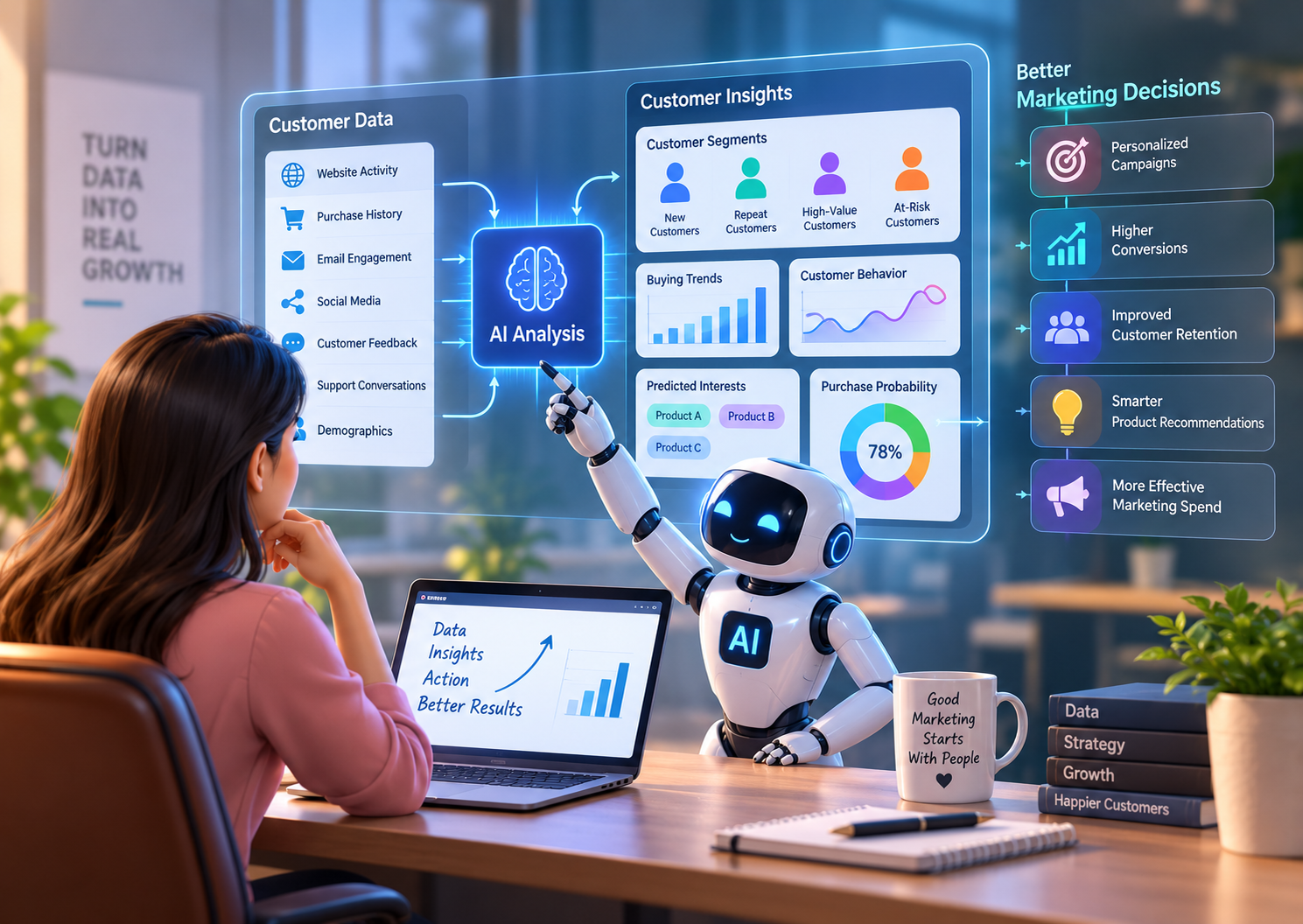
AI can help marketers personalise emails, advertisements, recommendations, and customer experiences.
But there is a limit.
Customers may appreciate:
“Here are three products based on what you recently viewed.”
But they may feel uncomfortable if a brand reveals too much information about their behaviour.
Good personalisation should feel useful.
Bad personalisation can feel intrusive.
Use relevant information carefully
Personalisation can include:
- Customer interests
- Previous purchases
- General preferences
- Location when genuinely useful
- Customer lifecycle stage
Always consider whether the information you are using is appropriate and whether customers would reasonably expect it to be used that way.
More personalisation is not always better.
6. Letting AI Make Every Marketing Decision
AI can analyse large amounts of information and identify patterns.
That can be extremely useful.
But marketers should not blindly accept every AI recommendation.
For example, an AI system might suggest changing:
- Target audience
- Campaign budget
- Content strategy
- Pricing
- Messaging
- Product positioning
The recommendation may be based on incomplete or outdated information.
There may also be business factors that the system cannot understand from the available data.
Use AI as a decision-support tool
Let AI help you:
- Find patterns
- Compare data
- Generate ideas
- Identify potential problems
- Summarise reports
- Explore different strategies
Then use human judgement to decide what actually makes sense for the business.
AI can help answer:
“What does the data show?”
People still need to consider:
“What should we do about it?”
7. Using AI Without Adding Anything Original
This may be the biggest problem of all.
If a customer can ask an AI tool the same question and receive almost the same answer, why should they follow your brand?
Your marketing needs something that belongs to you.
That could be:
- Original research
- Customer stories
- Case studies
- Product experience
- Expert opinions
- Industry data
- Unique examples
- Behind-the-scenes content
- Original photography
- Your company’s process
For example, instead of publishing:
“10 Tips for Better Social Media Marketing”
you could publish:
“What We Learned From Managing 50 Small Business Social Media Campaigns.”
The second idea contains experience that generic AI content cannot simply reproduce.
Why Authenticity Matters More in AI Marketing
As AI-generated content becomes easier to create, generic content becomes easier to produce.
That means originality becomes more valuable.
Businesses should ask:
What can we provide that an AI-generated generic article cannot?
Maybe it is your experience.
Maybe it is your customers.
Maybe it is your data.
Maybe it is your product.
Maybe it is your perspective.
AI can help you communicate those things faster.
But it cannot replace the underlying experience that makes your brand interesting.
How to Use AI Without Making Your Brand Feel Robotic
A simple approach is:
AI for Research
Use AI to gather ideas, identify questions, organise information, and explore topics.
Human for Strategy
Decide what your audience actually needs and what your brand should communicate.
AI for Drafting
Use AI to create initial versions of content.
Human for Editing
Add your voice, examples, opinions, experience, and brand personality.
AI for Repurposing
Turn existing content into different formats.
For example:
Blog ? Social Posts ? Email ? Short Video Script ? Infographic
Human for Final Approval
Check accuracy, tone, originality, and relevance before publishing.
This creates a balance between efficiency and authenticity.
A Simple AI Marketing Checklist
Before publishing AI-assisted marketing content, ask:
? Does this sound like our brand?
? Does it provide something useful?
? Have we checked the facts?
? Does it contain original information?
? Have we removed unnecessary AI-style phrases?
? Does the content match our audience?
? Are the visuals consistent with our brand?
? Have we reviewed any personalisation?
? Does the content have a clear purpose?
? Would a real customer find this useful?
If you cannot answer yes to most of these questions, the content may need another round of editing.
Final Thoughts
AI can make marketing faster, but speed should not come at the cost of authenticity.
The biggest AI marketing mistakes usually happen when businesses treat AI as a replacement for strategy, creativity, experience, and human judgement.
Use AI to handle repetitive work.
Use it to explore ideas.
Use it to analyse information.
Use it to repurpose content.
But give your marketing something AI cannot create on its own — your brand’s real experience, personality, perspective, and understanding of your customers.
The goal is not to hide that you use AI.
The goal is to make sure that your customers still feel like they are communicating with a real brand.
Frequently Asked Questions
Can AI-generated content make a brand look fake?
Yes, especially when content is published without editing, contains generic language, or lacks brand-specific information and real experiences.
Should businesses stop using AI for marketing?
No. AI can be useful for research, content creation, analysis, personalisation, automation, and many other marketing tasks. The key is using it with human oversight.
How can I make AI content sound more natural?
Add real examples, customer insights, brand-specific information, original opinions, and your normal communication style. Always review and edit AI-generated drafts before publishing.
Is using AI for social media marketing a bad idea?
No. AI can help with ideas, captions, content calendars, research, and repurposing. However, the final content should still reflect the brand’s personality and audience.
How much AI should a marketing team use?
There is no universal percentage. Use AI where it improves efficiency without reducing quality, accuracy, originality, or customer trust.
What makes AI marketing feel authentic?
Authentic AI marketing combines AI efficiency with human strategy, original ideas, real experiences, accurate information, and a consistent brand voice.