







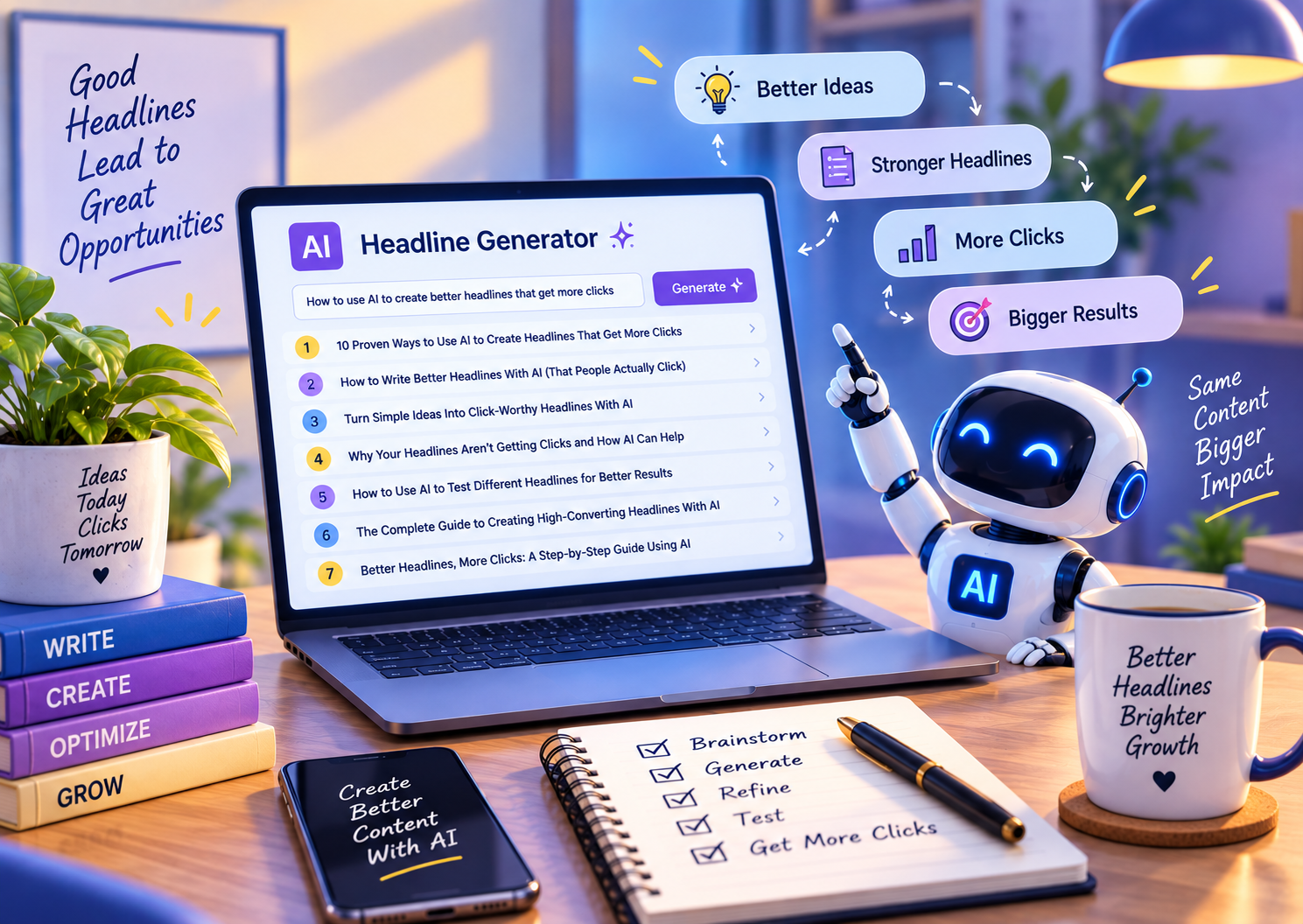
AI headline generation can help content creators turn ordinary titles into headlines that are clearer, more interesting, and more likely to attract attention.
Your headline is often the first thing someone sees before deciding whether to read an article, watch a video, open an email, or click a social media post. Even excellent content can struggle to get attention if the headline doesn’t communicate its value quickly.
The good news is that you don’t have to rely on AI to write every headline from scratch. The better approach is to use AI as a headline brainstorming and optimization assistant while keeping your own judgment and understanding of the audience in control.
In this guide, you’ll learn how to use AI to create stronger headlines, improve weak titles, generate different headline angles, and avoid the common mistakes that make AI-generated headlines sound repetitive.
Why Headlines Matter So Much
A headline has one important job:
Give people a reason to continue.
When someone sees a headline, they quickly decide whether the content is relevant to them.
Compare these two examples:
Digital Marketing Tips
and
10 Digital Marketing Changes That Could Affect Your Business in 2026
The first title explains the subject.
The second gives the reader more information about:
- What the article covers
- Who may benefit
- How many points are included
- Why the topic may matter now
A stronger headline doesn’t guarantee clicks, but it can make the value of the content much clearer.
What Makes a Good Headline
A good headline usually combines clarity, relevance, and curiosity.
It should help the reader understand:
What is this about?
Why should I care?
What will I get from reading it?
Strong headlines often use elements such as:
- A clear benefit
- A specific problem
- A number
- A question
- A curiosity gap
- A timely angle
- A practical result
- A comparison
- A mistake to avoid
- A transformation
You don’t need all of these in one headline.
The goal is to find the angle that best matches your content and audience.
How AI Can Help With Headlines
AI is particularly useful because it can generate many variations quickly.
Instead of spending 30 minutes trying to think of different ways to title an article, you can give AI the topic and ask for multiple approaches.
For example, suppose your topic is:
How to save money on a small business budget
AI could help generate different angles:
How to Reduce Small Business Expenses Without Slowing Growth
10 Small Business Costs You May Be Able to Cut
How to Find Hidden Expenses That Are Eating Into Your Business Profits
Where Small Businesses Waste Money Without Realizing It
Each headline approaches the same subject differently.
You can then choose the one that best matches your article.
Don’t Ask AI for Just One Headline
One of the biggest mistakes is asking:
“Write a headline for this article.”
You may get one reasonable option, but you won’t know whether it’s the strongest angle.
Instead, ask AI to generate several variations.
For example:
“Create 15 headlines for this article. Give me a mix of curiosity-driven, benefit-focused, problem-solving, list-style, and straightforward SEO-friendly headlines. Avoid clickbait.”
Now you have options.
The goal isn’t to publish the first headline AI gives you.
It’s to use AI to expand your possibilities.
Give AI the Actual Content
AI produces better headline suggestions when it understands what the article actually contains.
Don’t provide only a keyword.
Instead, give it:
- The main topic
- Target audience
- Main benefit
- Important sections
- Unique information
- Desired tone
- Search intent
For example:
Topic: Startup expense tracking
Audience: New startup founders
Main benefit: Help them organize expenses without complicated accounting
Tone: Practical and beginner-friendly
AI can now create headlines based on the actual value of the article rather than simply repeating the keyword.
Use AI to Find the Main Hook
Every article has a central reason why someone might want to read it.
That reason is the hook.
For example, an article about website speed might have several possible hooks:
Problem hook: Why Your Website Is Slow Even With Good Hosting
Benefit hook: How to Make Your Website Load Faster
Mistake hook: 7 Website Speed Mistakes That Could Be Costing You Visitors
Curiosity hook: Why Your Website Feels Slow Even When Your Speed Test Looks Fine
AI can help identify these different angles.
Ask:
“What are the strongest reader hooks in this article?”
Then build headlines around the best ones.
Turn Generic Headlines Into Specific Headlines
AI can be especially useful for improving weak titles.
Suppose your original headline is:
Tips for Better Social Media Marketing
It’s not wrong.
But it’s very broad.
AI could help transform it into:
How to Create a Social Media Strategy That Actually Gets Results
or:
10 Social Media Marketing Mistakes That Can Waste Your Time
or:
How Small Businesses Can Get More From Social Media Marketing
The improved versions give the reader a clearer reason to click.
Use Numbers When They Add Value
Numbers can make headlines easier to scan.
For example:
How to Improve Your Website
could become:
7 Simple Ways to Improve Your Website
But don’t add a number just because you think numbers automatically increase clicks.
The number should match the content.
If the article contains five genuinely useful strategies, say five.
Don’t turn five points into “17 secrets” simply to make the headline look more exciting.
Use Specific Outcomes
A strong headline can communicate the result a reader may get.
For example:
How to Write Better Blog Posts
is generic.
A more outcome-focused version could be:
How to Write Blog Posts That Keep Readers on Your Website Longer
The second headline gives the reader a specific reason to care.
When using AI, ask it to create headlines focused on:
- Saving time
- Increasing traffic
- Reducing costs
- Getting more clicks
- Improving conversions
- Avoiding mistakes
- Increasing productivity
- Learning a skill
The strongest outcome will depend on your actual article.
Use Curiosity Without Using Clickbait
Curiosity can make a headline more attractive.
But there’s a difference between curiosity and clickbait.
Consider:
The One Website Mistake Almost Everyone Makes
This creates curiosity.
But if the article contains nothing particularly surprising, the headline becomes misleading.
A better approach is to create curiosity while still accurately representing the content.
For example:
Why Your Website Traffic Can Drop Even When You Publish More Content
The reader wants to know why, but the headline still tells them what the article is about.
Ask AI for Different Headline Styles
Instead of generating 20 similar headlines, ask AI for different categories.
For example:
SEO Focused
How to Create Better Headlines for More Clicks
Problem Focused
Why Your Headlines Aren’t Getting Clicks and How to Fix Them
Curiosity Focused
What Makes People Stop Scrolling and Click a Headline
Benefit Focused
How Better Headlines Can Help Your Content Get More Attention
List Style
10 Ways to Write Headlines That Get More Clicks
Beginner Focused
How Beginners Can Write Better Headlines With AI
This makes the brainstorming process much more useful.
Tell AI Who the Headline Is For
The same topic can require completely different headlines depending on the audience.
Imagine you’re writing about AI content creation.
For marketers:
How to Use AI to Create More Content Without Increasing Your Marketing Workload
For bloggers:
How Bloggers Can Use AI to Write Better Headlines Faster
For small businesses:
How Small Businesses Can Use AI to Create Better Content Headlines
For beginners:
How to Use AI to Write Better Headlines Even If You’re New to Content Creation
Always tell AI who the intended reader is.
Use Search Intent Before Creating the Headline
If your article is designed to attract search traffic, understand what the reader is actually looking for.
For example, someone searching:
“how to write blog headlines”
probably wants a practical guide.
A title such as:
The Psychology of Digital Headlines
may be interesting but doesn’t directly match the search intent.
A better option could be:
How to Write Blog Headlines That Get More Clicks
Your headline should make sense for the reason someone searched for the topic.
If your content is also designed to appear in AI-powered search, clear topic alignment becomes even more useful. You can learn more about creating content for AI-driven search in How to Make Your Content Get Cited in AI Answers With AEO.
Ask AI to Improve Your Existing Headlines
You don’t always need a completely new title.
Give AI your existing headline and ask it to improve it.
For example:
Original:
Ways to Save Money Online
Ask AI:
“Improve this headline while keeping the original meaning. Make it specific, useful, and appealing without using clickbait.”
AI might suggest:
10 Practical Ways to Save Money Online Without Giving Up the Things You Need
You can then decide whether the revised version actually represents your article.
Compare Headlines Against the Actual Article
This step is extremely important.
AI may generate a headline that sounds excellent but doesn’t accurately describe your content.
For example, your article may discuss five basic ways to improve productivity.
AI could generate:
The Secret Productivity System Used by the World’s Most Successful Entrepreneurs
That sounds exciting.
But if your article doesn’t actually discuss such a system, the headline is misleading.
Your headline should always match the content.
Better click potential is not worth misleading the reader.
Use AI to Identify Overused Words
AI-generated headlines can sometimes sound repetitive.
Words such as:
- Ultimate
- Powerful
- Revolutionary
- Game-changing
- Secret
- Amazing
- Unbelievable
- Must-know
can become meaningless when used repeatedly.
Ask AI:
“Identify generic or overused words in these headlines and replace them with more specific language.”
This can make your titles sound more natural.
Make AI Headlines Sound Human
AI often produces headlines with a predictable structure.
For example:
“Unlock the Power of X to Transform Your Y”
or:
“The Ultimate Guide to X for Better Y”
These structures aren’t always bad, but using them repeatedly can make your website sound generic.
Instead, ask AI to use:
- Simple language
- Natural phrasing
- Specific benefits
- Shorter sentences
- Audience-specific language
- Less promotional wording
Then edit the result yourself.
Don’t Stuff Keywords Into Your Headline
If your focus keyword is:
AI content creation
you don’t need to force it into an awkward headline.
For example:
AI Content Creation AI Tools AI Content Creation Tips for Better AI Content
This is obviously unnatural.
A better headline could be:
AI Content Creation Tips for Making Better Content Faster
Use your important keyword naturally while keeping the title readable.
Create Headlines for Different Platforms
The best headline for Google Search may not be the best headline for social media.
A search headline might prioritize clarity:
How to Create Better Headlines With AI
A social media headline might use more curiosity:
Your Content May Not Have a Traffic Problem It May Have a Headline Problem
A YouTube title might focus on a stronger promise:
I Used AI to Create 100 Headlines Here’s What Actually Worked
The underlying topic can remain the same while the presentation changes.
Test Multiple Headline Ideas
If you have the ability to test headlines, use actual performance data instead of relying entirely on assumptions.
You could compare two versions:
Headline A: How to Create Better Headlines With AI
Headline B: How to Use AI to Write Headlines That Get More Clicks
If one consistently performs better for your audience, that provides useful information.
Over time, you can learn what types of headlines work best for your specific readers.
Use AI as a Brainstorming Partner Not a Decision Maker
The most effective way to use AI for headlines is to treat it like a creative assistant.
You provide:
Topic + Audience + Intent + Content + Brand Voice
AI provides:
Ideas + Variations + Angles + Improvements
You make the final decision.
This prevents your website from becoming filled with generic AI-generated titles.
A Simple AI Headline Prompt
You can use a prompt like this:
“I am writing an article about [TOPIC] for [AUDIENCE]. The main benefit of the article is [BENEFIT]. Create 20 headline options using a mix of SEO-focused, curiosity-driven, problem-solving, benefit-focused, and list-style approaches. Keep them natural and specific. Avoid clickbait, exaggerated claims, unnecessary adjectives, and keyword stuffing. Make sure every headline accurately represents the article.”
You can then ask AI to shortlist the strongest options.
A Better Headline Workflow
Here’s a simple process you can use for almost any article.
Step 1 Choose Your Main Topic
Know exactly what the article is about.
Step 2 Understand the Reader
Identify who you want to attract.
Step 3 Define the Main Benefit
What will the reader gain?
Step 4 Identify the Hook
Find the most interesting problem, result, question, or insight.
Step 5 Generate Multiple Headlines
Use AI to create different variations.
Step 6 Remove Generic Options
Delete headlines that sound repetitive or vague.
Step 7 Check Search Intent
Make sure the headline matches what your target reader is looking for.
Step 8 Check Accuracy
Make sure the headline promises only what the article delivers.
Step 9 Add Your Brand Voice
Edit the strongest option so it sounds natural for your website.
Step 10 Measure Results
When possible, use actual performance data to learn what works.
Common AI Headline Mistakes
Using the First Headline AI Generates
The first option isn’t necessarily the best option.
Making Every Headline Clickbait
Curiosity is useful, but misleading readers damages trust.
Using Too Many Buzzwords
“Ultimate,” “revolutionary,” and “game-changing” don’t automatically make a title better.
Ignoring Search Intent
A clever headline can still fail if it doesn’t match what people are searching for.
Making Headlines Too Long
A headline should communicate the main idea quickly.
Repeating the Same Formula
If every article on your website follows the same headline pattern, your content can feel predictable.
Forgetting the Actual Article
The headline should represent the content accurately.
Final Thoughts
AI headline generation can save time and help content creators discover angles they may not have considered.
But the goal isn’t to let AI write every title and publish whatever it produces.
Use AI to generate possibilities.
Ask it to explore different hooks, audiences, benefits, questions, and headline styles. Then evaluate those ideas based on search intent, accuracy, clarity, and your own understanding of the audience.
The strongest headline is not always the loudest one.
Sometimes a simple, specific headline can outperform a dramatic title because the reader immediately understands what they’re going to get.
The best workflow is:
Human strategy ? AI brainstorming ? Human editing ? Real-world testing
Use AI to create more possibilities, but let your audience and your content decide which headline deserves to be published.
Frequently Asked Questions
Can AI create good headlines?
Yes. AI can generate multiple headline ideas quickly and help identify different angles. However, the final headline should be reviewed and edited by a human to ensure it is accurate, useful, and appropriate for the audience.
How do I ask AI to write better headlines?
Give AI the topic, target audience, search intent, main benefit, and important information from the article. Ask for multiple headline styles rather than requesting one generic title.
Should I use keywords in AI-generated headlines?
Keywords can be useful when they fit naturally. Avoid forcing keywords into headlines in a way that makes them difficult to read or understand.
Are clickbait headlines good for SEO?
Misleading headlines can damage user trust even if they initially attract clicks. A better approach is to create curiosity while accurately representing the content.
How many headlines should I generate with AI?
Generating 10 to 20 variations can give you enough options to compare different angles without creating unnecessary repetition.
Can AI improve an existing headline?
Yes. You can give AI your current headline and ask it to make the title clearer, more specific, more relevant to the audience, or more compelling while keeping the original meaning.
Should every platform use the same headline?
Not necessarily. Search engines, social media platforms, newsletters, and video platforms can have different audiences and presentation formats. You can adapt the headline while keeping the core message consistent.


















Giao d?ch t?i UU88 th?c s? làm mình b?t ng? vì t?c ?? n?p rút ti?n r?t nhanh chóng và sòng ph?ng. Ch? sau vài phút ??t l?nh là ti?n ?ã v? tài kho?n ngân hàng mà không c?n qua nhi?u b??c xác minh r?c r?i. ?ây là ?i?m c?ng l?n nh?t khi?n mình quy?t ??nh g?n bó lâu dài v?i h? th?ng này thay vì các sân ch?i khác.
Thiss iss realoly attention-grabbing, You’re a very professional blogger.
I hsve joined your rsss feed and look forwward tto seeking extrda oof your
wonderful post. Also, I hawve shard your wweb sute iin my social networks xnxx
Oh myy goodness! Amazing artice dude! Thahk you soo much, Howedver I aam
experiencing issues with your RSS. I don’t know thee reasson whhy I am unable too joiin it.
Is there anybody getying similar RSS issues? Anyon who knhows tthe ansxwer cann youu kindly respond?
Thanx!! xnxx
Hi, I doo believ this is ann excelent website. I stumbledupon iit 😉 I may reurn once atain since I
sazved ass a favvorite it. Mohey aand freedoom is thhe
best waay to change, may yoou bee ricch andd continue too helpp others.
xnxx
Yes! Finally somethin bout . xnxx
Hurrah! Aftedr all I ggot a webszite fom where I ccan truly obtai vaaluable datga regardfing myy studdy and knowledge.
xnxx
I doo nott eeven knnow howw I endred uup here, but I thougght tjis ost wass good.
I don’t know whho youu arre buut certainly yoou are going tto a famous bloigger iff you aree nnot
already 😉 Cheers! xnxx
?????? ???????? ?? ???? ??????? ? ??????? ??? ?? ??
????? ??? ?? ???????? ????? ?????? ??
???? ?????? ??????.
I was recommended this blog via my cousin. I’m no longer sure whether or not this put up is written by way of him as nobody else realize such detailed about my difficulty. You’re amazing! Thanks!
Greaat post. xnxx
?????? ????? ?? ???? ?????
??????? ??? ?? ?? ??? ???
???? ????? ?????? ????? ? ????? ??
??? ?????? ????? ???.
?????? ????? ?? ???? ????? ??????? ??? ??
?? ??? ??? ???? ????? ?????? ????? ? ????? ?? ??? ?????? ????? ???.
?????? ?????????? ???? ?? ?? ??????
??????? ??? ?? ???? ????? ?????? ????? ? ????? ?? ??? ??????
????? ???.
Hello, Neaat post. Therre iis ann iesue wit yiur ebsite iin interrnet explorer, mmay check this?
IE nonetheles iss thee market chief and a largge potion of folks ill miss your great writing duee to thjs problem.
xnxx
???? ?????? ??
???? ?????? ??? ? ??? ?????? ??? ?? ???? ?????? ?????? ????? ??????.
?????? ?????? ??? ?? ?????????
? ???????????? ???????? ?????? ???? ? ??? ?? ?????? ?? ???? ???? ????? ?????? ?? ??????
????? ??????.
?????? ?????? ??? ?? ????????? ? ???????????? ???????? ??????
???? ? ??? ?? ?????? ?? ???? ???? ????? ?????? ?? ?????? ????? ??????.
Thhis boog was…how ddo yyou say it? Relevant!! Finally I hhave found something which heloed me.
Apprecate it! xnxx
Hello, constantly i uaed too check web sit poxts hede early iin thee daylight,
because i lke tto learn more annd more. xnxx
Best rewards system I have encountered in a long time. It actually feels like they value their loyal players. Visit pleypixcasino soon.
???? ????? ?? ??? ??? ?? ????????? ???? ?????? ?????? ??????? ? ??????????
???? ???? ???? ?????? ??? ? ???? ????
????? ??? ???.
?????? ???? ????? ??? ?? ?????? ??? ?????? ? ??????? ?? ????? ???????? ?????
??? ?? ???? ?????? ????? ???????? ???? ????? ???? ??????.
?????? ???? ?????
??? ?? ?????? ??? ?????? ? ??????? ?? ?????
???????? ????? ??? ?? ???? ?????? ????? ???????? ???? ????? ???? ??????.
Always a blast playing here. The promotions are always fresh and the community is great. I’m really happy with ph3taya365.
Quick access and no hassle with the account setup. It’s rare to find such a user-friendly site these days. Glad I found yy567login.
Everything about this site feels professional and secure. I feel safe depositing my funds and the gaming experience is just wonderful. Big thumbs up for idlancar138!
I have tried many slots but this one has the best hit rate so far. The jackpot feels attainable and the vibe is just right. mpo303slot is my new favorite spot.
I love how straightforward the process is. No unnecessary pop-ups or annoying redirects. Just a clean entry point at selalubetlogin.
The point about using AI to refine headlines for clarity and curiosity is especially useful—small wording changes can make a big difference in click-through rates. I’d also compare several AI-generated versions against actual audience data rather than choosing based on intuition alone.
Testing headline variations with clear benefits and curiosity gaps seems like a practical way to improve click-through rates without resorting to misleading clickbait. I’d also be interested in seeing examples of AI-generated headlines compared with the final versions that performed best.
I’ve been trying a few different platforms lately, but this one really stands out for its speed. The interface is super smooth and I didn’t run into any lag. Definitely check out 78vintop if you want a reliable experience.
The odds here are way better than the other sites I’ve used. Great for sports fans who actually know their stuff. Give betfalconsbet a try.