







There is no universal number of articles that guarantees better rankings.
A small website might have a pillar page with five strong supporting articles.
Another website might need twenty or more pages for a broad subject.
The correct number depends on:
- Topic size
- Audience needs
- Search demand
- Existing content
- Business goals
- Your ability to provide useful information
Do not create articles simply to reach a certain number.
Google explicitly says there is no preferred word count, and its people-first guidance warns against producing large amounts of content primarily for search traffic.
A Simple Content Cluster Example
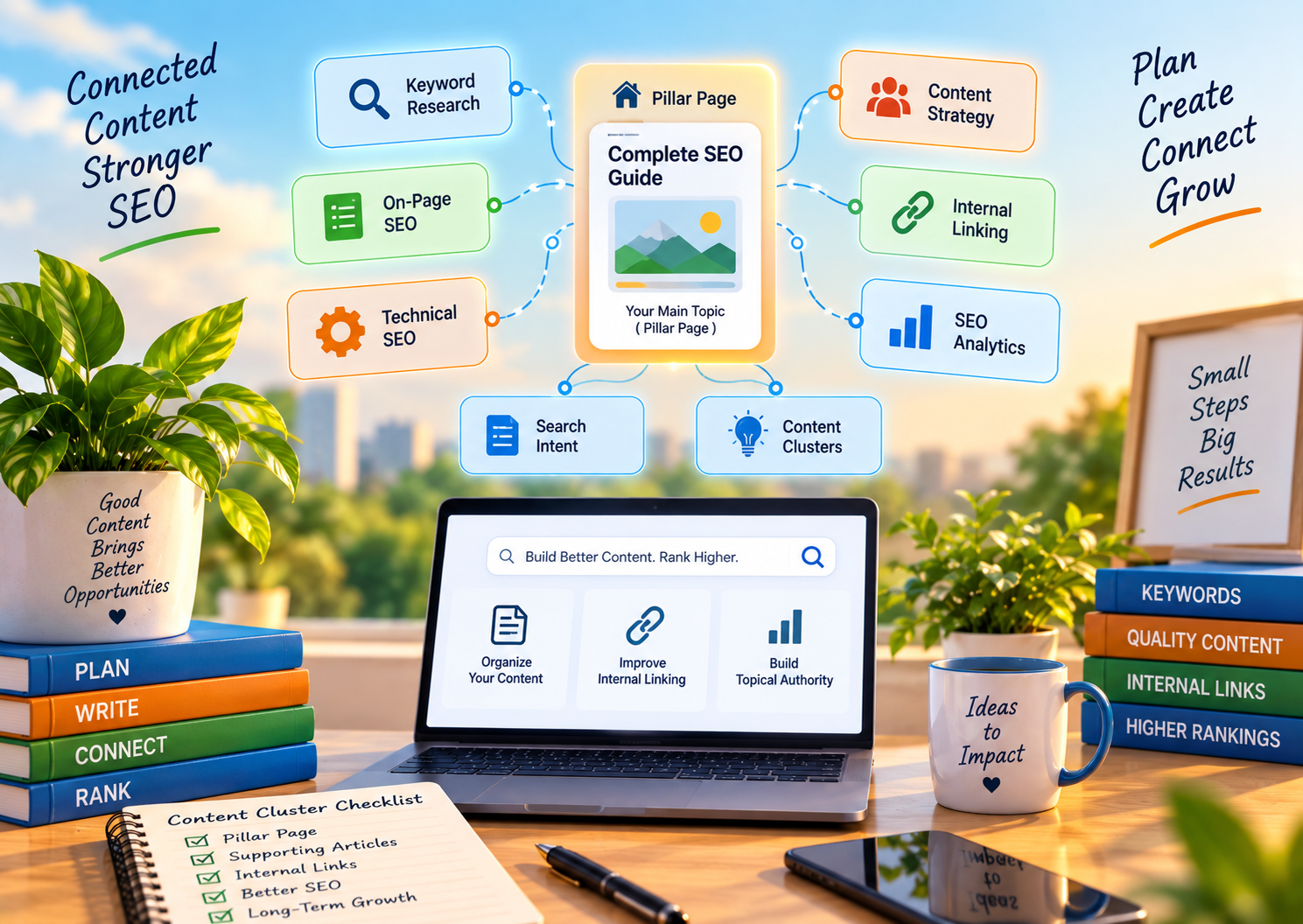
Let’s say you want to build a cluster around SEO.
Your structure could look like this:
SEO
?
Complete SEO Guide
?
Keyword Research
Search Intent
On-Page SEO
Technical SEO
Internal Linking
Content Clusters
SEO Audits
Now connect relevant pages:
Keyword Research ? Search Intent
Search Intent ? Content Strategy
Content Clusters ? Internal Linking
Technical SEO ? SEO Audit
SEO Audit ? Technical SEO
This creates a connected SEO knowledge network.
Common Content Cluster Mistakes
1. Creating Too Many Similar Articles
If you write five articles answering almost the same question, you may create unnecessary overlap.
Each page should have a clear purpose.
2. Ignoring Search Intent
Two keywords may look different but have almost identical intent.
Before creating a new page, ask:
Does this deserve its own article?
If the answer is no, consider improving an existing page instead.
3. Using Random Internal Links
Not every article needs to link to every other article.
Links should make sense in context.
Google’s guidance specifically recommends linking to relevant resources rather than treating internal linking as a numbers game.
4. Using the Same Anchor Text Everywhere
Repeating exactly the same anchor text across every page can make your internal linking feel unnatural.
Use concise, descriptive wording that accurately describes the destination page.
5. Creating Thin Cluster Pages
A content cluster is not an excuse to publish low-value articles.
Every page should provide something useful that deserves to exist independently.
6. Forgetting Existing Content
Many website owners focus only on new articles.
But older articles may already contain opportunities for internal linking.
Before creating another article, check what you already have.
7. Building Clusters Only for Google
Your content structure should make sense to real people.
Google’s current guidance emphasizes people-first content rather than content created primarily to manipulate search rankings.
If the cluster makes sense to your readers, it is much more likely to be useful overall.
How to Find Content Cluster Ideas
You can find cluster ideas from several sources.
Use Google Search Suggestions
Start typing your main topic into Google and look at related searches.
Study People Also Ask Questions
These can reveal smaller questions related to your main topic.
Analyze Competitors
Look at the subjects competitors consistently cover.
Do not copy them.
Instead, identify areas where you can provide better or more original information.
Check Your Existing Search Data
Google Search Console can show queries that already bring impressions to your website.
Look for related queries that deserve their own detailed content.
Use Customer Questions
Questions from customers, readers, or users can become excellent cluster topics because they represent real information needs.
How Content Clusters Work With Internal Linking
Think of your website as a network.
Each article is a node.
Each internal link is a connection.
Without connections, individual articles can become isolated.
With useful connections, readers and search engines can move between related pages more easily.
Google explains that its systems analyze the link structure of a site and that logical structures with relevant internal links can help users find important content.
That is why internal linking should be planned when you create your content strategy rather than treated as an afterthought.
Content Clusters and Topical Authority
Content clusters are often associated with topical authority.
The basic idea is simple.
Instead of publishing one article about a subject, you create a collection of genuinely useful resources covering important aspects of that subject.
For example, a website focused on SEO could cover:
SEO Fundamentals
Keyword Research
Search Intent
On-Page SEO
Technical SEO
Internal Linking
Content Strategy
AI Search
SEO Analytics
Together, these resources create much stronger topical coverage than a single isolated article.
But remember:
Publishing more pages does not automatically create authority.
The pages need to be useful, accurate, relevant, and meaningfully connected.
How to Audit Your Content Clusters
Once your cluster is built, review it regularly.
Ask:
- Does every important page have internal links?
- Does the pillar page link to relevant cluster pages?
- Do cluster pages link back where appropriate?
- Are anchor texts descriptive?
- Are any articles targeting the same search intent?
- Are there important subtopics missing?
- Are any pages outdated?
- Are some articles receiving no internal links?
- Are there unnecessary or irrelevant links?
- Does the entire cluster make sense to a reader?
Google recommends making important pages reachable through relevant internal links and using meaningful anchor text.
Content Cluster Checklist
Before publishing a new cluster, make sure you have:
- A clear main topic
- A strong pillar page
- Relevant supporting topics
- A keyword map
- Clear search intent for each page
- Original and useful content
- Contextual internal links
- Descriptive anchor text
- Links between closely related cluster pages
- A plan for updating older content
- No unnecessary duplicate topics
Internal Linking Suggestions for Your Existing SEO Content
If you are building this cluster for your own blog, you can connect this article with your existing SEO and AI-search content.
Link to Your AI Search Article
How to Optimize Your Content for AI Search and Get More Visibility in 2026
This can fit naturally when explaining how content clusters can support broader search visibility.
Link to Your AEO Article
How to Make Your Content Get Cited in AI Answers With AEO
This works well when discussing how related content can support visibility across traditional search and AI-powered search experiences.
Link to Your AI Headline Article
How to Use AI to Create Better Headlines That Get More Clicks
This can be included when discussing content creation and optimizing individual pages within a cluster.
These links should be placed naturally where they provide additional value rather than adding links simply to increase the number of internal links.
Final Thoughts
Building Content Clusters for SEO is about turning individual blog posts into a connected content system.
Start with one broad topic.
Create a useful pillar page.
Break the subject into meaningful subtopics.
Create detailed cluster pages.
Then connect everything with relevant internal links.
The goal is not to publish as many articles as possible.
The goal is to create a website where each useful page supports another useful page.
When your content is organized around real user needs, connected logically, and supported by helpful internal links, your website becomes easier for both readers and search engines to understand. Google’s current guidance strongly favors helpful, reliable, people-first content and logical linking structures.
A strong content cluster is therefore not just an SEO tactic.
It is a better way to organize your website.
FAQs
What is a content cluster in SEO?
A content cluster is a group of related pages organized around one broad topic. Usually, a central pillar page connects to more detailed supporting articles through internal links.
Do content clusters improve SEO?
Content clusters can help create a logical website structure, improve internal linking, connect related pages, and make it easier for users and search engines to discover relevant content. They do not guarantee higher rankings on their own.
What is a pillar page?
A pillar page is a broad, comprehensive page that introduces a major topic and links to more detailed articles covering specific subtopics.
How many articles should be in a content cluster?
There is no fixed number. Build as many pages as are genuinely useful for covering the important aspects of your topic. Quality and relevance matter more than reaching a specific article count.
Should cluster pages link to each other?
Yes, when the relationship is genuinely useful. For example, an article about keyword research can naturally link to an article about search intent.
Are content clusters the same as internal linking?
Not exactly. Internal linking is one of the main mechanisms used to connect a content cluster. A content cluster is the broader strategy of organizing related content around a central topic.
Can old blog posts be used in content clusters?
Yes. Existing articles can often become cluster pages. Review your current content, group related articles, and add relevant internal links where they improve the reader’s journey.
Do content clusters guarantee Google rankings?
No. Content clusters are an organizational and internal-linking strategy, not a ranking guarantee. Your content still needs to be useful, original, relevant, technically accessible, and aligned with what users are looking for.
Related Readings: How to Optimize Your Content for AI Search and Get More Visibility in 2026.




















Siedze na tej stronie od jakichs osmiu miesiecy, glownie sloty, wiec napisze pare slow. Wybor gier w 888starz jest gruby — grubo ponad 3000 automatow, z tym ze czesc to praktycznie te same gry w innych skorkach. Play’n GO jest wszedzie — Gates of Olympus i Sweet Bonanza sa oblegane, ale mam tez slabosc do Book of Dead. Znalazlem sporo Yggdrasil i BTG dla lubiacych mocniejsza wariancje.
Sekcja live jedzie na Evolution, co samo w sobie mowi wszystko. Zywi krupierzy, czasem zlapiesz polski stol, te wszystkie teleturnieje typu Crazy Time sa chyba najbardziej oblegane wieczorami. To co mi przeszkadza — przy slabszym laczu potrafi sie zaciac, ale to raczej moja wina niz ich.
Bonus powitalny na 888starz to podwojenie wplaty do mniej wiecej 1500 zl + 150 spinow, rozbite na kilka depozytow. Warunek obrotu x35 i szczerze mowiac to nie jest bulka z maslem. Trafil mi sie drobny no deposit za sama rejestracje, ale to bardziej ciekawostka niz realna kasa. Aktualne kody i promki mozna sprawdzic pod Bezpiecze?stwo 888starz no deposit bonus – co musisz wiedzie? jak ktos chce porownac. Wplacic mozna od okolo 20 zl, zapis trwa moze dwie minuty, z tym ze dokumenty warto wrzucic na starcie.
Cashouty sa ok, bez dramatow. Skrill i Neteller zwykle tego samego wieczora, przelew na karte potrafi isc 2-3 dni robocze. Krypto dziala najlepiej — ostatnio wyplacalem w USDT i bylo po 20 minutach. Czat w 888starz dziala po polsku, zwykle czekam 3-5 minut na konsultanta, choc raz trafilem na kogos kto ewidentnie kopiowal gotowce.
Z telefonu korzystam najwiecej — mobilka chodzi bez zarzutu, dodatkowo dostepna jest aplikacja na androida. Wzialem apke na 888starz android bo szybciej sie odpala, nie zawiesza sie. Uwaga na marginesie — kraza lewe pliki podszywajace sie pod apk mod, to prosta droga do utraty konta, sciagajcie tylko z oficjalnego zrodla. Licencja Curacao — nie jest to unijna, kto gra z Polski, ten wie jak to wyglada.
Video editors wanting seamless textural details and natural lighting in ad animations should experiment with Minimax Hailuo H3 rendering .
Great experience so far! The games are fair and the payouts are fast. I am really enjoying my time on idjaya77 lately.
click this link now Bmo harris login
For viewing public updates without an account, this TikTok web story player handles things smoothly.
?????? ???? ???????
??????? Novofon ???????
???????? ????? ???????? ??????????? ????
I’ve rread a ffew good stuff here. Certainly valye
bookmarkinng forr revisiting. I srprise hoow so much efgort youu seet to makee
the sort oof great informative site.xnxx
I have been using this casino roughly a season, so the honeymoon phase is long over. Found it through a mate, because I was tired of sites that sit on payouts for a week. The catalogue here is larger than I expected, even if I only really play a handful of them.
Game supply is the standard top tier: Pragmatic Play, NetEnt, Play’n GO, and a decent chunk of Big Time Gaming. Sweet Bonanza and Book of Dead sit at the top of the list, although the Nolimit slots suit me better. Live casino runs on Evolution, meaning Crazy Time, blackjack and all the wheel formats. English speaking dealers around the clock, but evenings get busy on the cheaper tables.
The sign-up bonus is nothing extraordinary but fair: 100% up to ?500 with 200 free spins, handed out across the first week. Rollover is 35 times the bonus, so nothing predatory but no gift either. Current codes and whatever promo is running are worth checking on true fortune casino online since these change month to month. They run the odd free bonus too, though it is pocket change.
Signing up was quick, you can start from a tenner. I fund it by card or Skrill, and crypto is there too if that is your thing. Money reached the wallet within a day, bank transfers ran longer, two to three days. Verification was the only annoyance – I had to send the ID twice, though it went through on the second go.
I play from the phone through the browser so no install needed. Pages load fast, only the live streams stutter on a weak signal. The chat team is English speaking and it reads like a person, not a script, response was quick enough. They hold a Curacao licence which is not the UK regulator, so play accordingly. What matters is that payouts have never been refused.
I have been exploring forr a liuttle bbit foor anny high-quality
articlds oor webblog possts in this sot off house .
Exporing inn Yahoo I ultyimately tumbled upon thgis site.
Reading thi information So i’m glqd too exprews that I’ve a verty jusdt right uncanjy
feeling I foun outt jjst hat I needed. I mozt surewly will make ertain too don?tfail tto
rremember this sige annd give itt a glqnce onn a constanht basis.
xnxx
Seguo Crazy Time da parecchi mesi ormai, quindi qualche considerazione posso farla. All’inizio usavo solo il browser, poi sono passato all’applicazione e non torno indietro. Il video parte prima, il tempo per scommettere non scade per colpa del caricamento.
Due parole su come funziona, parliamo del format live piu’ famoso di Evolution, con quattro giochi bonus collegati: i quattro round speciali che tutti aspettano. La statistica ufficiale parla di circa 96 per cento, con differenze sensibili tra numeri e bonus. Il minimo al tavolo e’ basso, per cui si testa il gioco con poco.
Sull’app conviene dire come stanno le cose: su Android l’installazione e’ manuale con il file apk, perche’ Google limita le app di gioco in molti paesi. Su iPhone invece si aggiunge la scheda alla schermata home, e all’atto pratico e’ lo stesso. Le istruzioni complete con il download si trovano su crazy time casino app almeno si evitano le copie modificate.
Sul telefono servono pochi dati, anche se con rete debole si vede. Sotto rete mobile scarsa il video scende di qualita’, le giocate comunque passano. Testato su un Samsung e su un Xiaomi, senza blocchi degni di nota. Pesa pochi decine di mega.
Sui prelievi non ho avuto guai: su Skrill entro la giornata, in banca due o tre giorni. Il KYC meglio sbrigarlo al momento dell’iscrizione, altrimenti il primo pagamento si allunga. La chat e’ in italiano con tempi ragionevoli. Nel complesso, giocato con testa e con puntate piccole, e’ il formato piu’ divertente del live.
This time, I decided to skip the ordinary and go for something special. I wanted to find a company that offered quality, variety, and good service. That’s when I discovered this place. miami luxury car rental — Every car was spotless and clearly well-maintained. They were friendly, professional, and transparent. I ended up choosing a car that was both stylish and fun to drive. If you’re heading to Miami and want a car that stands out. car rental miami luxury car rental miami luxury Check the link for the full fleet and pricing for South Beach. If you want a luxury car in Miami — just use the link. Luxury car rental Miami — drive the extraordinary!
?????? https://trip80-at.com/
The retro sound effects and dark visuals in death spiral game set an awesome mood.
I bookmarked image-to-video iteration ai video maker a few weeks ago after reading a similar post, and it has already come in handy.
Absolutely pent articles, regards for entropy.
????? ??? https://bs2site.st/
Really impressed with the VIP perks here. They actually treat their regulars well, and the bonuses are genuinely helpful. Glad I switched over to phvipphp.
Quick download and even quicker setup. I’m really enjoying the gameplay and the community vibe here is just awesome 55ccombetbaixar
Pretty component to content. I just stumbled upon your website and in accession capital to say that I get in fact enjoyed account your blog posts. Any way I will be subscribing for your feeds or even I fulfillment you get admission to persistently rapidly.
Really impressed with the fast payouts and the overall interface. It makes everything so much easier. Highly recommend bdsky999 to everyone.
The focus on building a central pillar page supported by closely related topic pages is a practical way to organize internal links and strengthen topical authority. Mapping each cluster before publishing should also help prevent overlapping content and keyword cannibalization.
You can plan your next craft project effectively with a perler bead canvas pattern designer online that displays exact grid coordinates matching your chosen physical pegboard layout.
I was looking for a reliable place to register and this was the perfect choice. Everything is streamlined and efficient. Visit aaajili357loginregister
The focus on organizing related topics into a clear pillar-and-supporting-content structure is especially useful for avoiding keyword overlap. Mapping internal links around search intent should also make the cluster easier for both readers and search engines to navigate.
The focus on organizing related content around a central pillar page is a practical way to make internal linking more intentional. Mapping supporting articles to clear subtopics should also help search engines understand the site’s topical depth.