





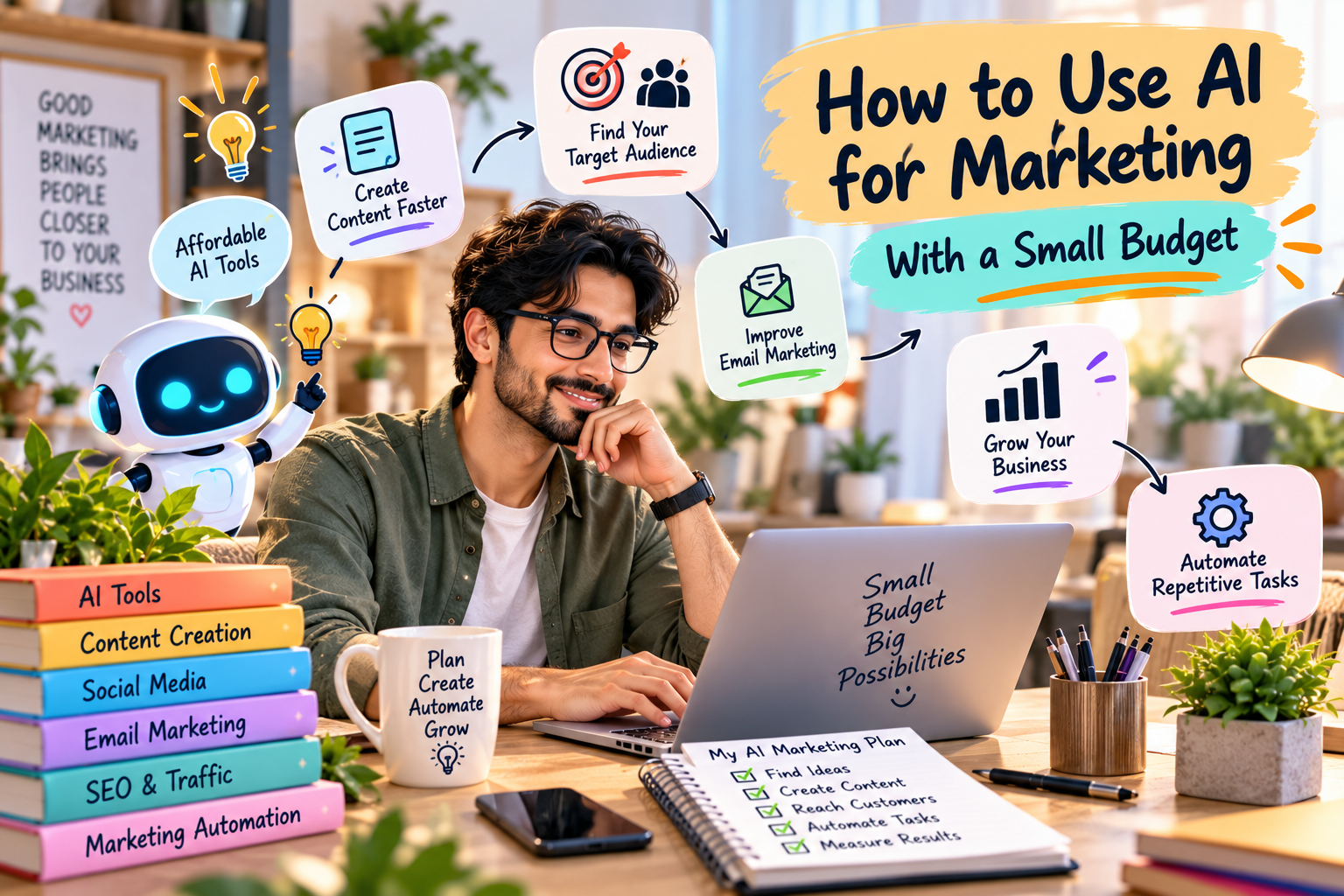
Learning how to use AI for marketing with a small budget can help small businesses create better content, reach potential customers, and save time without hiring a large marketing team. You do not need to pay for dozens of expensive tools to get started. You need to identify your biggest marketing problems and use AI where it can make a real difference.
Many small businesses struggle with limited budgets, inconsistent social media posting, slow content creation, and a lack of time for marketing. AI tools can help with these tasks, but buying more tools does not automatically produce better results.
The smartest approach is to start with a few affordable tools, build a simple workflow, and measure whether your marketing is improving.
1. Start With Your Biggest Marketing Problem
Before choosing an AI tool, identify what is slowing down your marketing.
For example, you might struggle with:
- Coming up with social media ideas
- Writing captions and blog posts
- Creating promotional graphics
- Responding to customer questions
- Planning email campaigns
- Researching competitors
- Understanding marketing performance
Do not try to automate everything at once.
If creating social media content takes several hours every week, start there. If your website gets visitors but few enquiries, focus on improving your website content and conversion process instead.
AI works best when it solves a clear problem rather than becoming another expense to manage.
2. Use Free AI Tools Before Paying for Subscriptions
You can begin experimenting with AI marketing using free plans and tools you already have access to.
Depending on current plan limits and availability, useful categories include:
- AI writing assistants for brainstorming, outlines, and first drafts
- Design tools for creating marketing graphics and visual concepts
- SEO tools for keyword research and content analysis
- Email marketing platforms with built-in automation features
- Analytics tools for understanding website and campaign performance
- Scheduling tools for planning social media content
Examples include ChatGPT for brainstorming and drafting, Canva for design assistance, Google Analytics for website measurement, and free or entry-level SEO tools for research.
Features, usage limits, and pricing can change, so check each tool’s current plan before depending on it.
You do not need to use every tool. Start with one writing assistant and one design or analytics tool if those match your needs.
3. Create a Month of Social Media Ideas With AI
Small businesses often struggle to post consistently because they run out of ideas.
AI can help you build a content plan around your products, services, audience questions, and business goals.
For example, if you run a local furniture store, you could ask an AI assistant to suggest content about:
- Choosing furniture for small rooms
- Furniture care tips
- Product comparisons
- Common buying mistakes
- Customer questions
- New product arrivals
- Seasonal offers
You can then organise the ideas into educational posts, product posts, customer stories, and promotional content.
Use a prompt such as:
“Act as a social media strategist for a small furniture store. Suggest 20 useful Instagram post ideas for homeowners. Include educational topics, product demonstrations, customer questions, and promotional ideas. Keep the suggestions practical and avoid repeating the same concept.”
Review the ideas before using them. Add real product information, your own experience, and details about your customers.
AI can help you plan content faster, but your posts should still sound like your business.
4. Turn One Idea Into Multiple Marketing Assets
You do not need to create every piece of content from scratch.
One useful topic can become several different marketing assets.
For example, a blog post about choosing the right website hosting service could become:
- Three social media posts
- A short video script
- An email newsletter
- A simple infographic
- A list of frequently asked questions
- A short LinkedIn post
This process is called content repurposing.
Start with one useful piece of original content, then adapt it for each platform. Do not simply copy the same text everywhere. A short video needs a different structure from a blog article.
This approach helps you get more value from the time you spend researching and creating content.
5. Use AI to Write Better Marketing Drafts
AI writing assistants can help you prepare first drafts for captions, emails, landing pages, product descriptions, and blog articles.
However, the quality of the result depends heavily on the information you provide.
Instead of asking, “Write a marketing post for my business,” give the tool more context.
Include:
- Your business type
- Your target audience
- The product or service
- The main customer problem
- Your brand voice
- The purpose of the content
- Any factual details that must remain accurate
For example:
“Write three Instagram caption drafts for a local bakery promoting its weekend cake collection. Use simple, friendly English. Focus on freshness and flavour, avoid exaggerated claims, and include a clear invitation to visit the shop.”
Review the output for accuracy, tone, originality, and relevance before publishing.
For more guidance, explore [How to Use AI to Create Marketing Content People Actually Want to Read] as a related topic for your AI marketing strategy.
6. Create Promotional Graphics More Efficiently
Professional-looking visuals can make marketing content easier to understand, but hiring a designer for every small promotion may not fit a tight budget.
AI-assisted design tools can help you brainstorm layouts, explore colour combinations, generate visual concepts, and prepare initial drafts.
For example, a small clothing store could use AI to plan a seasonal campaign, suggest creative directions, and prepare variations for social media posts.
To keep your branding consistent:
- Use the same brand colours
- Choose a consistent font system
- Keep your logo unchanged
- Use clear product photographs
- Maintain readable text sizes
- Check every generated visual carefully
AI-generated visuals may contain incorrect text, unrealistic products, or inconsistent brand elements. Correct these issues before publishing.
Use AI to reduce repetitive work, not to sacrifice the quality of your marketing materials.
7. Improve Your Website Content With AI
Your website is often one of the first places potential customers learn about your business.
AI can help you review website copy, improve page structure, identify missing information, and make service descriptions easier to understand.
You can ask it to review a service page and suggest improvements to:
- The main headline
- The opening paragraph
- Service descriptions
- Frequently asked questions
- Calls to action
- Internal links
- Common customer concerns
For example, a website designer could use AI to identify questions a small business owner may ask before hiring a designer.
The resulting content could explain pricing factors, project timelines, website maintenance, and the information clients need to prepare.
Always verify claims and ensure that the content reflects your actual services. AI should not invent testimonials, guarantees, qualifications, or business details.
8. Use AI for Basic Customer Research
You do not always need expensive research software to start understanding your customers.
AI can help organise information you already have, such as customer reviews, support questions, survey responses, and feedback.
Suppose a small online store receives repeated questions about delivery times and product sizes.
You could organise those questions and ask an AI assistant to group them into themes. Those themes may reveal opportunities for clearer product descriptions, a better FAQ page, or more useful social media content.
AI can also help you brainstorm customer personas, but its suggestions are hypotheses rather than proof.
Use real customer feedback and available business data to validate what you learn. Avoid uploading sensitive customer information to tools that are not approved for that purpose.
9. Automate Small, Repetitive Marketing Tasks
You do not need a complex automation system to save time.
Start with one repetitive task that follows a predictable process.
Examples include:
- Organising content ideas into a calendar
- Preparing draft email responses
- Creating a weekly marketing summary
- Sending permitted follow-up emails
- Sorting incoming enquiries
- Repurposing approved content
- Summarising campaign performance
Use built-in features or free automation allowances where available.
Keep human approval for important activities such as sending promotional campaigns, responding to complaints, making public claims, or changing advertising budgets.
For a more detailed approach, read [How to Automate Repetitive Marketing Tasks With AI]. It can help you decide which tasks are suitable for automation and which still need human judgement.
10. Use AI to Improve Email Marketing
Email marketing can help small businesses stay connected with interested customers without relying entirely on paid advertising.
AI can assist with subject-line ideas, email outlines, audience-specific drafts, and content planning.
For example, a small online store could create different email drafts for:
- New subscribers
- Customers who recently purchased
- Customers interested in a particular product category
- People who have not purchased recently
Use real customer preferences and consent-based data to make messages more relevant.
Avoid pretending that you know personal details about a subscriber when you do not. Also, do not send mass promotional emails without following applicable consent, privacy, and unsubscribe requirements.
The goal is to make communication more useful, not simply to send more messages.
11. Research Competitors Without Buying Expensive Reports
AI can help you organise publicly available information about competitors and identify areas worth investigating.
For example, you can compare publicly visible website pages, product categories, blog topics, and marketing messages.
Use AI to create a comparison framework covering:
- Target audience
- Main offers
- Content themes
- Website messaging
- Customer questions
- Potential content gaps
Then verify the findings yourself.
AI may misunderstand a competitor’s business, overlook important details, or make unsupported claims. Treat its analysis as a starting point rather than a complete market research report.
Avoid collecting private information or accessing systems you are not authorised to use.
12. Measure Results Before Spending More Money
One of the biggest mistakes small businesses make is paying for new tools without knowing whether their existing marketing is working.
Start with a few simple measurements.
| Marketing goal | What to track |
|---|---|
| Website visibility | Relevant visits and search impressions |
| Social media awareness | Reach, views, and engagement |
| Lead generation | Enquiries and qualified leads |
| Email marketing | Clicks, responses, and conversions |
| Online sales | Orders and conversion rate |
| Productivity | Time saved on repetitive tasks |
Choose metrics that match your actual business goals.
For example, if you use AI to draft social media posts, measure whether the process saves time and whether the content performs adequately. If you use AI to improve a landing page, measure enquiries or conversions rather than focusing only on page views.
Compare results over a reasonable period and account for other changes that might influence performance.
13. Avoid Paying for Tools You Do Not Need
AI subscriptions can quickly become expensive when you sign up for several tools that perform similar tasks.
Before paying for a tool, ask:
- What specific problem will it solve?
- Can a tool I already use handle this task?
- Does the free plan meet my current needs?
- Will the time saved justify the cost?
- Can I test the tool before committing?
- Is the tool appropriate for my business data?
Keep a simple list of subscriptions and review it regularly.
Upgrade only when you have a clear reason, such as reaching usage limits, needing a specific feature, or saving enough time to justify the expense.
A small, well-chosen toolset is often easier to manage than a collection of disconnected subscriptions.
14. Build a Simple Weekly AI Marketing Routine
Here is an example of a manageable routine for a small business.
Monday: Research customer questions and plan content ideas.
Tuesday: Use AI to prepare first drafts of captions, emails, or blog outlines.
Wednesday: Create and review marketing graphics.
Thursday: Publish content and respond to customer questions.
Friday: Review website, social media, and lead-generation results.
Weekend or quieter periods: Organise next week’s content and improve existing assets.
Adjust this schedule to your workload. The purpose is not to use AI every day; it is to make marketing more organised and consistent.
A Simple 30-Day Plan for AI Marketing on a Small Budget
Week 1: Identify your needs
Choose one marketing problem and select one or two tools that can help solve it.
Week 2: Create useful content
Prepare a small batch of content using AI assistance. Review the drafts, add your own expertise, and publish the best pieces.
Week 3: Improve your workflow
Identify repetitive tasks and create a simple process to handle them more efficiently.
Week 4: Measure and refine
Review the results, calculate any time saved, and decide whether the process deserves more investment.
You do not need to automate every marketing activity within 30 days. Start with improvements you can maintain.
Common AI Marketing Mistakes to Avoid
Publishing unedited AI content
AI can produce generic wording, inaccurate information, and repetitive ideas. Review and improve every important piece of content.
Buying too many subscriptions
More tools do not automatically lead to better marketing. Choose tools based on specific needs.
Automating without checking results
An automated process can repeat mistakes quickly if nobody reviews it.
Ignoring your brand voice
Make sure AI-assisted content sounds like your business and reflects your audience’s expectations.
Expecting instant sales
AI can help with research, content, and efficiency, but it cannot guarantee leads, sales, or profit.
Sharing sensitive customer data carelessly
Use appropriate privacy controls and avoid entering confidential information into tools without understanding how the data is handled.
Frequently Asked Questions
Can I use AI for marketing without spending money?
Yes. Many tools offer free plans or limited free features that can help with brainstorming, writing drafts, design, research, and analytics. Check current usage limits and choose tools that fit your needs.
Which AI tool is best for small business marketing?
There is no single best tool for every business. The right choice depends on whether you need help with content, design, research, automation, or analytics. Start with the task that consumes the most time.
Can AI replace a marketing team?
AI can assist with many repetitive marketing tasks, but strategy, customer understanding, creative judgement, fact-checking, and relationship building still require human oversight.
Is AI marketing useful for local businesses?
Yes. Local businesses can use AI to plan social media content, improve website copy, draft promotional emails, organise customer questions, and prepare campaign ideas.
How can I measure whether AI marketing is working?
Track relevant outcomes such as qualified leads, enquiries, conversions, website engagement, and time saved. Compare results before and after making changes rather than relying only on the number of posts produced.
Should a small business pay for AI marketing tools?
Not immediately. Start with free or existing tools, test whether they solve a real problem, and upgrade only when the additional features or time savings justify the cost.
Final Thoughts
Using AI for marketing with a small budget is less about finding the most expensive software and more about making better use of the resources you already have.
Start by identifying your biggest marketing challenge. Use a small number of suitable tools to create useful content, understand customers, simplify repetitive work, and improve your website or campaigns.
Keep people involved in decisions that affect your customers and brand reputation. Check facts, protect customer information, and measure results before investing in more subscriptions.
You do not need a big marketing budget to begin using AI effectively. You need a clear goal, a practical workflow, and the discipline to improve it over time.