




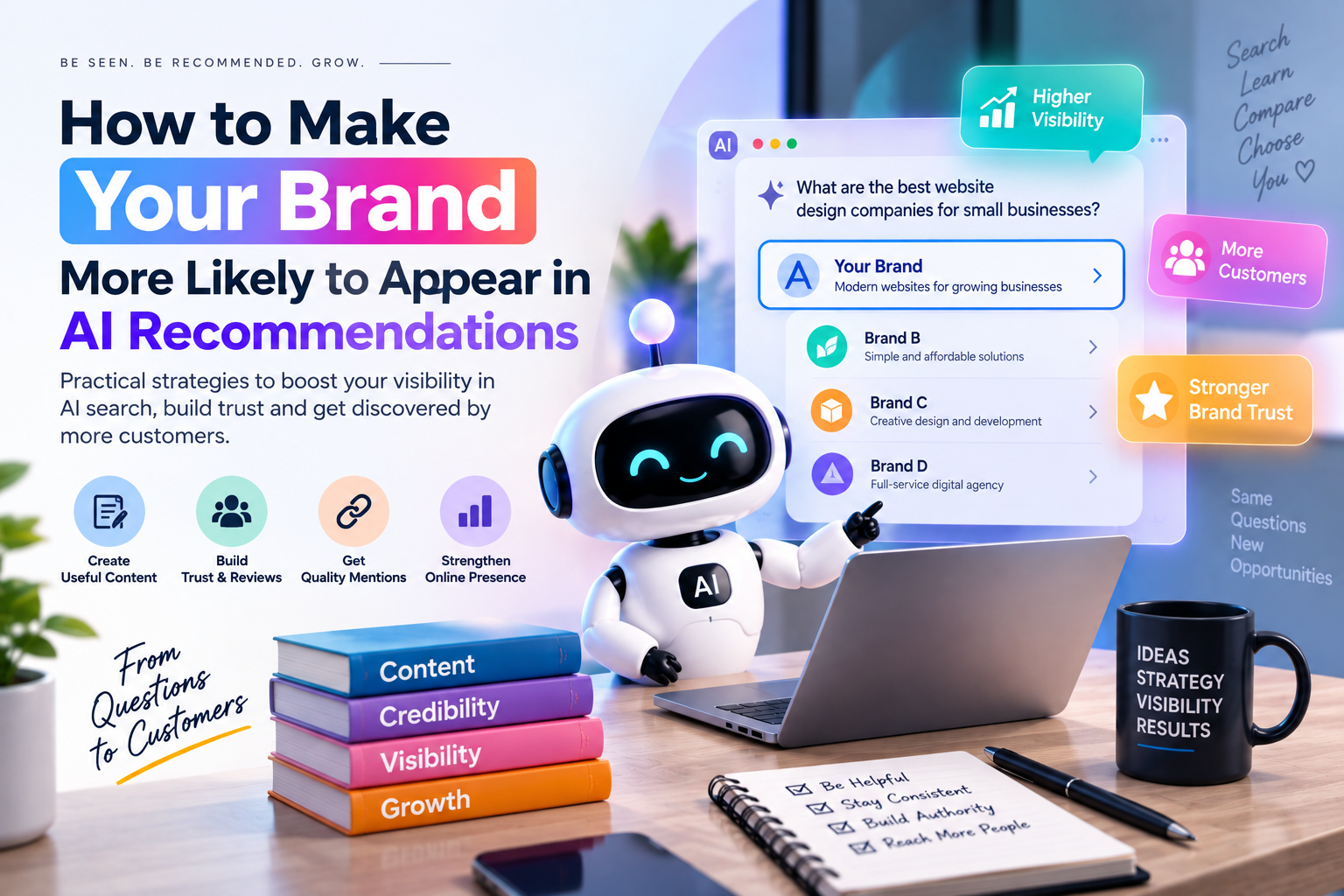
AI Recommendations are becoming an important part of how people discover products, services, and businesses online. Instead of searching through traditional results, users can now ask AI tools questions such as “Which software is best for a small business?” or “What are the best brands for this product?” and receive a conversational answer with different recommendations.
This creates a new opportunity for digital marketers.
Your brand does not only need to appear on Google anymore. It also needs to be understandable, discoverable, and well represented across the wider web so that AI systems have reliable information when generating answers.
There is no guaranteed formula for making an AI system recommend a particular brand. However, businesses can improve their overall digital visibility by creating useful content, maintaining accurate information, earning genuine mentions, collecting authentic reviews, and building authority around their industry.
What Are AI Recommendations?
An AI brand recommendation happens when an AI system mentions a company, product, or service as a relevant option in response to a user’s question.
For example, someone might ask:
“What are some good project management tools for a small team?”
An AI system may mention several brands and explain what each one is suitable for.
This is different from traditional advertising because the brand may be included as part of an AI-generated answer rather than a paid advertisement.
The recommendation can depend on the user’s question, available information, sources, product details, and the AI system’s own retrieval and ranking processes.
Why AI Recommendations Matter for Marketing
Traditional digital marketing often focuses on search rankings, website traffic, clicks, impressions, and conversions.
AI-powered discovery introduces another layer.
A customer might ask an AI tool for recommendations, compare several options, and then visit only a few websites.
This means your brand may need to become visible before the customer reaches your website.
For marketers, this makes brand mentions, useful content, reviews, product information, and third-party references increasingly important parts of digital visibility.
1. Make Your Brand Information Easy to Understand
AI systems need information about your business to understand what you actually offer.
Your website should clearly explain:
- What your business does
- Which products or services you provide
- Who you serve
- Where you operate
- What makes your offering different
- Which problems you solve
- How customers can contact you
Avoid relying entirely on vague marketing language.
Instead of:
“We deliver innovative solutions for modern businesses.”
say exactly what you provide.
For example:
“We provide website design, software development, SEO, and digital marketing services for small and medium-sized businesses.”
Clear information is easier for people and search systems to understand.
2. Create Dedicated Product and Service Pages
Do not put every service your business offers on one generic page.
Create dedicated pages for important services and products.
For a digital marketing company, this could include:
- SEO
- Social media marketing
- Google Ads
- Website design
- Content marketing
- Email marketing
Each page should explain the service, its benefits, ideal customers, process, use cases, and frequently asked questions.
This gives search systems more specific information about your business.
3. Answer Questions Your Customers Actually Ask
One of the most useful ways to improve your online visibility is to answer real customer questions.
Think about what people ask before buying.
For example:
- What is the best CRM for a small business?
- How much does SEO cost?
- Which website platform is best for an online store?
- What should I look for in accounting software?
- Which marketing tool is easiest for beginners?
Create detailed content that genuinely answers these questions.
Do not simply repeat keywords.
Include examples, comparisons, limitations, use cases, and practical advice.
4. Focus on Specific Search Intent
AI questions are often much more conversational than traditional searches.
Someone may not simply search:
“Best accounting software.”
They may ask:
“What accounting software is easiest for a small business owner who has never used accounting software before?”
The second question contains much more information about the user’s needs.
Create content around these specific situations.
Instead of writing one generic article called:
“Best Software Tools”
create something more specific such as:
“Best Accounting Software for Freelancers With Simple Invoicing Needs.”
Specific content can help your brand become relevant to particular customer questions.
5. Build Genuine Brand Mentions
Your website is not the only place where your brand exists.
AI systems can encounter information about businesses through different online sources, including:
- Industry publications
- Business directories
- Reviews
- News websites
- YouTube
- Forums
- Partner websites
- Professional profiles
- Product pages
The objective is not to create hundreds of artificial mentions.
Instead, build a legitimate online presence where your brand is discussed naturally and accurately.
6. Get Mentioned for Something Specific
A generic brand mention provides little information.
For example:
“ABC is a company.”
does not tell a potential customer much.
A more useful mention could be:
“ABC provides cloud-based accounting software designed for freelancers and small businesses.”
Now the brand is connected with a specific category and audience.
Think about what you want customers to associate with your brand.
It could be:
- Affordable website design
- Premium skincare
- Beginner-friendly accounting software
- Local home construction
- Enterprise cybersecurity
- Sustainable fashion
Clear positioning helps people understand your business more quickly.
7. Keep Your Business Information Consistent
Imagine your website says:
“ABC Digital provides SEO services for small businesses.”
But another directory describes the company as:
“ABC Digital is a social media agency.”
Another profile calls it:
“A full-service advertising company.”
Different descriptions can create confusion.
Keep important information consistent across your:
- Website
- Business profiles
- Social media accounts
- Directories
- Review platforms
- Product listings
Make sure your brand name, services, location, and contact information are accurate.
8. Build Genuine Customer Reviews
Reviews can provide useful information about real customer experiences.
Instead of collecting only generic comments such as:
“Great service!”
encourage customers to describe what they purchased and what problem it solved.
For example:
“The website redesign helped our local business improve mobile usability and increase online enquiries.”
This provides much more context.
Never create fake reviews or manufacture customer experiences.
Authentic feedback is more valuable for your reputation and your audience.
9. Create Comparison Content
People frequently ask AI systems comparison questions.
Examples include:
- Product A vs Product B
- Best alternatives to a particular tool
- Which software is better for beginners?
- Which service is better for small businesses?
Create useful comparison content that explains genuine differences.
Include:
- Features
- Pricing
- Strengths
- Limitations
- Ideal users
- Use cases
- Important differences
Avoid making every comparison simply conclude that your own product is the winner.
Useful comparisons should help readers make informed decisions.
10. Publish Original Research
Original information can make your website more valuable.
Instead of publishing another generic article about your industry, create information that other websites can reference.
You could publish:
- Customer surveys
- Industry statistics
- Case studies
- Experiments
- Product tests
- Original data
- Expert interviews
- Trend reports
For example, a marketing company could survey small businesses about their biggest digital marketing challenges.
Other websites may then reference the findings, creating additional visibility for your brand.
11. Create Detailed Case Studies
Case studies demonstrate what your business actually does.
A strong case study can explain:
The Problem
What was the customer struggling with?
The Approach
What did your business do?
The Result
What changed?
The Lessons
What can other businesses learn?
This gives your brand context beyond promotional claims.
12. Do Not Rely Only on AI-Generated Content
AI can help marketers with research, brainstorming, outlines, and content production.
But publishing large quantities of generic AI-generated articles is not a substitute for expertise.
Add information that gives your content something unique:
- Original examples
- Expert opinions
- Data
- Case studies
- Product experience
- Unique observations
- Real customer questions
The goal should be useful content, not simply more content.
13. Make Your Website Technically Accessible
Your content cannot be easily discovered if search crawlers cannot access it.
Check important technical elements such as:
- Robots.txt
- Noindex settings
- Canonical tags
- Internal links
- Page accessibility
- Mobile usability
- Site speed
- Broken pages
AI visibility does not mean traditional SEO suddenly becomes irrelevant.
Technical SEO still plays an important role in making your content accessible.
14. Make Important Facts Easy to Find
Do not make visitors search through multiple pages to discover basic information.
Put important facts in clear locations.
Your website should have useful sections such as:
About Page
Who you are.
Service Pages
What you offer.
Product Pages
What you sell.
Contact Page
How customers can reach you.
FAQ
Answers to common questions.
Reviews
What customers say about you.
This creates a clearer information structure around your business.
15. Build a Strong Brand Identity Online
AI systems need to understand what your brand represents.
Clearly communicate:
- Business name
- Website
- Industry
- Location
- Products
- Services
- Target audience
- Relevant social profiles
For local businesses, keep business information accurate across relevant directories and business platforms.
For online brands, make sure your official website clearly explains your identity and category.
16. Create Content Around Your Industry
Do not only publish articles about your own company.
If you sell cybersecurity software, create useful content about:
- Phishing
- Password security
- Account protection
- Malware
- Data breaches
- Online privacy
If you sell marketing software, cover:
- Marketing automation
- Lead generation
- Email marketing
- Customer segmentation
- Campaign measurement
This helps establish topical relevance around your industry.
17. Earn Mentions Instead of Manufacturing Them
There is a major difference between earning visibility and creating artificial visibility.
Avoid:
- Fake reviews
- Fake accounts
- Spam comments
- Fake forum mentions
- Automated community posts
- Keyword-stuffed profiles
- Mass-produced guest posts
Instead, focus on:
- Genuine PR
- Original research
- Expert commentary
- Industry partnerships
- Customer stories
- Useful resources
- Authentic community participation
The objective is to build a credible digital presence.
18. Create Content That Is Worth Citing
AI-powered search can use web sources when generating answers.
That means your content should provide something genuinely useful.
Instead of:
“Our software is the best.”
create content such as:
“How We Tested 15 Project Management Tools for Small Teams.”
Then explain your methodology and findings.
Or create:
“Project Management Features Small Businesses Actually Need.”
Then provide useful criteria and examples.
The second type of content gives readers more substance and can make the page more valuable as a reference.
19. Think Beyond Google Rankings
Google rankings remain important, but digital discovery is becoming more distributed.
Your brand may be discovered through:
- Search engines
- AI search
- Social media
- YouTube
- Reviews
- News websites
- Industry publications
- Product databases
This is why modern digital marketing should focus on building a strong digital footprint rather than depending entirely on one platform.
20. Monitor How AI Describes Your Brand
One practical way to understand your AI visibility is to test questions that potential customers might ask.
Try questions such as:
“What are the best [product category] brands?”
“What companies provide [service]?”
“What are alternatives to [competitor]?”
“Which [product] is best for [specific audience]?”
Then check:
- Is your brand mentioned?
- Is the information accurate?
- Which competitors appear?
- Which sources are referenced?
- Are there incorrect claims?
- What questions produce no mention?
This can help you identify gaps in your online presence.
A Simple AI Visibility Strategy
You can start with this framework.
Step 1 — Define Your Brand
Clearly explain what you do, who you serve, and which category you belong to.
Step 2 — Build Useful Pages
Create detailed service, product, comparison, FAQ, and educational pages.
Step 3 — Answer Customer Questions
Find real questions and create useful answers.
Step 4 — Build Credibility
Earn genuine reviews, mentions, citations, partnerships, and industry coverage.
Step 5 — Strengthen Technical SEO
Make sure important pages are accessible to search crawlers.
Step 6 — Build Topical Authority
Create connected content around your industry and expertise.
Step 7 — Monitor AI Results
Regularly test relevant customer questions across AI search tools.
Step 8 — Keep Information Updated
Correct outdated or inconsistent information across your website and important third-party sources.
What Not to Do
Do not treat AI visibility as a game that can be manipulated with shortcuts.
Avoid:
Keyword Stuffing
Repeating the same phrase excessively does not make a brand more trustworthy.
Fake Reviews
Never manufacture customer experiences.
AI Content Farms
Publishing hundreds of shallow articles is not a replacement for expertise.
Spam Mentions
Do not flood forums and communities with your brand name.
Fake Comparisons
Do not create misleading comparison pages simply to promote your own business.
Unsupported Claims
Do not make statements that cannot be backed up.
The goal is to make your brand genuinely useful and easy to understand.
AI Recommendations Are Not the Same as Traditional Rankings
Traditional search generally provides users with a list of results.
AI systems can instead generate a conversational answer using information from different sources.
This creates several forms of digital visibility.
Mentioned
The AI names your brand.
Cited
The AI provides your website or content as a source.
Associated
Your brand becomes connected with a particular category, product, service, or problem.
Recommended
Your brand is presented as a relevant option for a particular need.
These forms of visibility are related but are not exactly the same.
Final Thoughts
Getting your brand into AI recommendations is not about finding a secret trick that forces an AI system to mention your business.
It starts with something much simpler.
Make your brand easy to understand, easy to discover, and worth recommending.
Create useful content.
Answer real customer questions.
Keep your business information accurate.
Build genuine reviews and mentions.
Publish original research and case studies.
Make your website technically accessible.
And regularly check how AI systems describe your brand.
AI-powered discovery is developing quickly, and different systems can use different sources and processes. There is no guaranteed formula for getting a brand recommended.
Instead of chasing shortcuts, build a digital presence that clearly demonstrates what your business does, who it helps, and why it is useful.
That approach can support visibility across search engines, AI tools, social platforms, communities, and the wider web.
Frequently Asked Questions
How can I make my brand appear in AI recommendations?
Start by making your brand information clear and accurate, publishing useful content, answering customer questions, building genuine online mentions and reviews, and maintaining a technically accessible website.
Does SEO still matter for AI recommendations?
Yes. AI discovery and traditional search can overlap because AI systems may retrieve information from the web. Technical accessibility, useful content, clear information architecture, and online authority remain important.
Can I guarantee that an AI tool will recommend my brand?
No. There is no guaranteed method for getting a brand recommended. Results can vary depending on the user’s query, available sources, product information, and the AI system being used.
Do brand mentions help with AI visibility?
Relevant and genuine brand mentions can provide additional context about what a company does. However, simply increasing the number of mentions does not guarantee that an AI system will recommend the brand.
Should I create content specifically for AI?
Create content primarily for people, but make the information clear, accurate, useful, structured, and accessible. Good content can serve both human readers and search systems.
How can I check whether AI recommends my brand?
Create a list of questions your potential customers might ask and test those questions across relevant AI tools. Record which brands appear, which sources are cited, and whether the information about your business is accurate.