







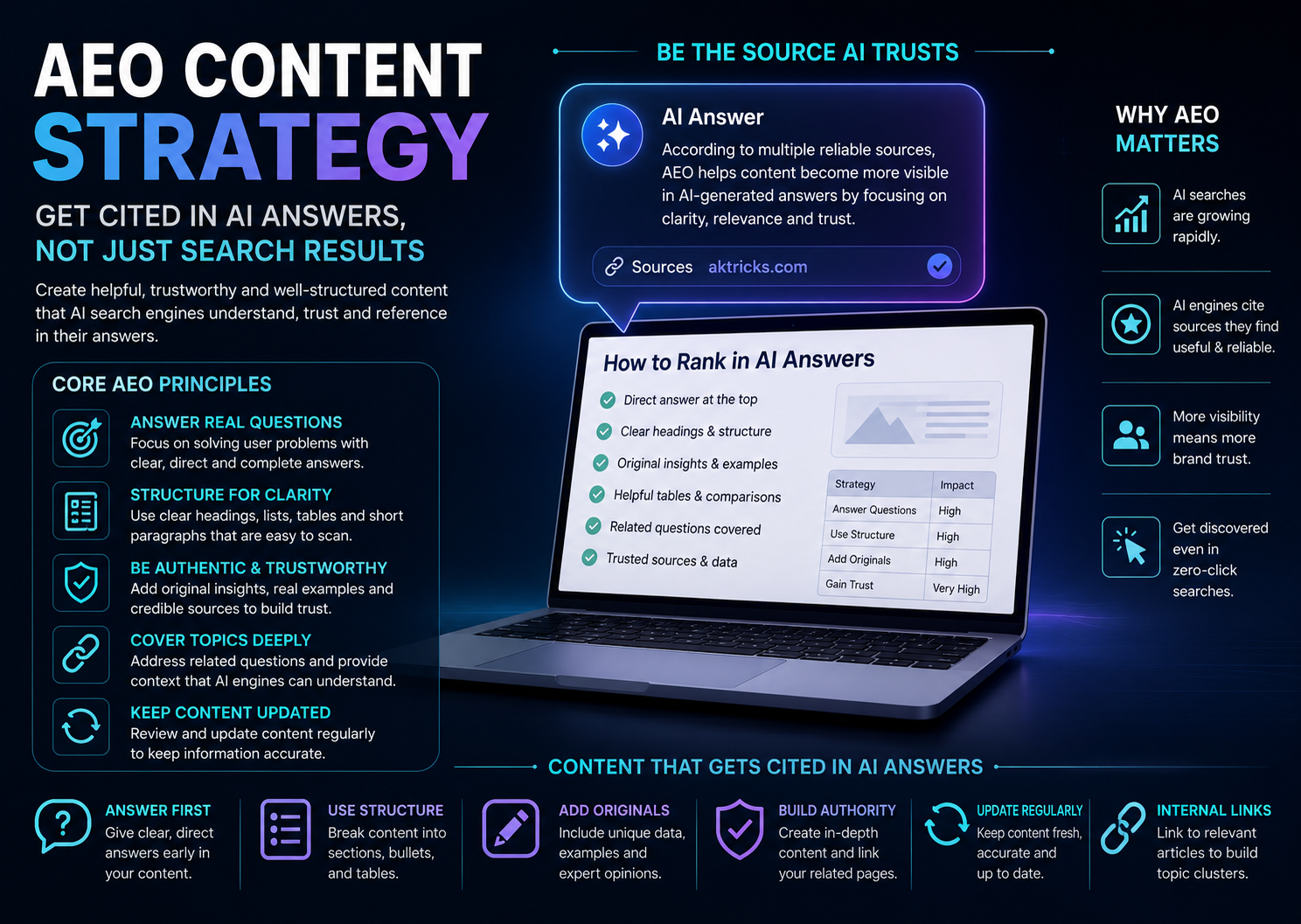
AEO content strategy is becoming less about simply ranking for keywords and more about creating information that AI search systems can understand, trust, and use in their answers.
When someone asks ChatGPT, Google AI Overviews, Perplexity, Gemini, or another AI-powered search system a question, the system may combine information from multiple sources before producing an answer. Your website doesn’t just need to appear in search results anymore. Your content needs to be useful enough to become part of the answer.
Google’s current guidance also emphasizes creating unique, helpful content, making pages accessible to search systems, and providing information that offers genuine value rather than simply producing content for search visibility.
So how can you create content that AI systems are more likely to understand, reference, and cite?
Let’s look at the practical AEO strategies that matter.
Stop Writing Only for Keywords
Traditional SEO often starts with a keyword.
For example:
“best email marketing tools”
But an actual user might ask:
“What is the best email marketing tool for a small business with a limited budget?”
These are not exactly the same.
AI-powered search increasingly works around complete questions, context, and intent rather than isolated keywords. Your content should therefore answer the real question behind the search.
Instead of creating an article that repeatedly targets one keyword, build the article around:
- The main question
- Related questions
- User problems
- Comparisons
- Examples
- Common follow-up questions
- Practical recommendations
This gives an AI system more useful information to work with.
Put the Best Answer Near the Top
One of the simplest AEO improvements is also one of the easiest to overlook.
Don’t make readers search through 1,500 words to discover the answer.
If your article is answering:
“How can a small business get more website traffic?”
Give a clear answer early.
Then explain the reasoning, examples, strategies, and details afterward.
A strong structure can look like this:
Question: How can a small business get more website traffic?
Direct answer: A small business can increase website traffic by combining useful SEO content, local search optimization, social media distribution, email marketing, and partnerships.
Detailed explanation: Explain each strategy underneath.
This makes the content easier for both humans and AI systems to understand.
Create Answer Blocks Inside Your Articles
Think of individual sections of your article as small answers.
Instead of writing huge paragraphs, create compact sections that can stand on their own.
For example:
What Is a Good Blog Posting Frequency?
A good blog posting frequency depends on your resources and audience. For many small websites, publishing one or two genuinely useful articles each week is more sustainable than publishing several low-quality posts every day.
Then expand on the topic.
This approach makes individual sections easier to understand and potentially easier for answer engines to extract.
Answer Related Questions You Haven’t Targeted Yet
People rarely ask only one question.
Someone searching:
“How to start affiliate marketing”
may later want to know:
- How much money do I need?
- Can I start without a website?
- How long does it take to make money?
- Which products should I promote?
- How do I get traffic?
- What mistakes should beginners avoid?
Instead of creating disconnected articles for every tiny variation, build comprehensive content that naturally addresses important follow-up questions.
This can make your website more useful and help establish stronger topical coverage.
Use Original Information Instead of Rewriting Everyone Else
This is one of the most important opportunities for AEO.
AI systems already have access to enormous amounts of repetitive information.
If ten websites say essentially the same thing, another article saying the exact same thing adds little value.
Try adding something original:
- Your own testing
- Original statistics
- Case studies
- Screenshots
- Personal observations
- Comparisons
- Examples
- Expert opinions
- Survey results
- Step-by-step experiments
Google’s guidance for AI search specifically encourages unique, valuable content rather than content that simply reproduces information already available elsewhere.
Make Your Claims Easy to Verify
AI systems need reliable information.
That means your content should make important claims easier to understand and verify.
For example, instead of writing:
“Email marketing is extremely effective.”
Explain what you mean.
You could write:
“Email marketing can help businesses communicate directly with existing subscribers without depending entirely on social media algorithms.”
The second statement is clearer and more specific.
For statistics, research findings, industry claims, and important facts, provide trustworthy sources whenever appropriate.
Build Content Around Real Problems
AEO isn’t only about answering definitions.
Some of the most useful content answers problems.
For example:
Instead of:
“What Is Website Speed?”
Try:
“Why Is My Website Slow Even With a Good Hosting Plan?”
Instead of:
“What Is Affiliate Marketing?”
Try:
“Why Are People Clicking My Affiliate Links but Not Buying?”
Instead of:
“What Is SEO?”
Try:
“Why Is My Website Not Ranking Even After Publishing 50 Articles?”
These topics naturally create stronger opportunities for detailed, practical answers.
Use Tables When Comparisons Matter
Tables can make complicated information easier to understand.
Suppose you’re comparing website traffic strategies:
| Strategy | Cost | Difficulty | Long-Term Potential |
|---|---|---|---|
| SEO | Low to Medium | Medium | High |
| Paid Ads | Medium to High | Medium | Medium |
| Social Media | Low | Medium | Medium |
| Email Marketing | Low | Medium | High |
| Referral Marketing | Low | Low | Medium |
A reader can understand the comparison quickly.
Structured information like tables, lists, and clearly labeled sections can also make important information easier to interpret and extract.
Don’t Hide Important Information Behind Fluff
A common problem with online content is unnecessary introduction.
For example:
“In today’s rapidly changing digital world, businesses are constantly looking for new and innovative ways…”
The reader already knows they’re reading about digital marketing.
Get to the point.
Instead:
“Small businesses can increase online visibility by focusing on search intent, useful content, local SEO, and consistent distribution.”
Clear writing is better for users and easier for machines to interpret.
Strengthen Your Website’s Topical Authority
A single article rarely establishes strong authority around an entire subject.
Imagine your website has one article about affiliate marketing.
Now imagine it has articles covering:
- How to Start Affiliate Marketing
- How to Choose Affiliate Products
- How to Get Your First Affiliate Sale
- How to Use Pinterest for Affiliate Marketing
- How to Create Affiliate Content
- How to Get Affiliate Traffic Without Paid Ads
- How to Track Affiliate Links
- Affiliate Marketing Mistakes Beginners Should Avoid
The second website provides much deeper coverage.
Your articles can also link to one another where appropriate, creating a connected content ecosystem.
Use Internal Links Strategically
Internal links aren’t only useful for SEO.
They also help users move from one answer to another.
For example, if you’re writing about AEO and discussing how AI search is changing content discovery, you can naturally direct readers to your existing article:
How to Optimize Your Content for AI Search and Get More Visibility in 2026
This gives readers a deeper resource while connecting related content on your website.
Don’t add dozens of random internal links. Use links where the additional article genuinely helps answer the reader’s next question.
Make Your Content Easy to Scan
People don’t read online content the same way they read books.
They scan.
Use:
- Short paragraphs
- Descriptive headings
- Bullet points
- Numbered steps
- Tables
- Examples
- Bold important phrases
- Clear conclusions
A page that looks like one giant block of text is difficult to use.
Good formatting helps humans find answers faster and gives AI systems clearer sections to interpret.
Show Who Created the Content
Trust matters.
Your website should make it reasonably clear:
- Who wrote the article
- Who operates the website
- What the website is about
- Whether the information has been reviewed or updated
- When the article was published or updated
This becomes especially important for content involving finance, cybersecurity, health, technology, or other subjects where accuracy matters.
Keep Important Pages Updated
AEO isn’t a one-time activity.
Information changes.
Tools change.
Prices change.
Technology changes.
Search behavior changes.
An article that was accurate two years ago may contain outdated information today.
Review important articles periodically and update:
- Statistics
- Examples
- Screenshots
- Tools
- Links
- Recommendations
- Dates
- Outdated information
Don’t update an article simply to change its date. Update it when there is something meaningful to improve.
Don’t Create Separate Articles for Every Tiny Question
AEO does not mean creating hundreds of extremely short pages.
If you have five closely related questions, they may belong in one strong article.
For example, instead of creating separate 300-word articles for:
- How to get website traffic
- How to increase website traffic
- How to get more visitors
- How to improve website traffic
- How to attract website visitors
you could create one genuinely useful guide covering the topic comprehensively.
Google’s guidance also warns against creating content primarily to capture variations of searches rather than serving users.
Create Content That Can Be Quoted
Think about this question while writing:
“Which sentence from this article would I want another website or AI system to use?”
That’s your citation-worthy information.
For example:
Weak:
“Businesses should focus on good content.”
Stronger:
“Publishing more articles does not automatically increase organic traffic; businesses need content that satisfies a specific search intent and provides information competitors don’t.”
The second statement contains a clear idea.
You can make your content more citation-worthy by including:
- Original findings
- Clear explanations
- Specific comparisons
- Useful statistics
- Unique examples
- Strong conclusions
- Expert commentary
Build Your Brand Beyond Your Website
AEO shouldn’t be treated as an on-page-only strategy.
Your website is only one part of your online presence.
Your brand may also appear on:
- Industry websites
- News websites
- YouTube
- Social media
- Business directories
- Forums and communities
- Review platforms
- Podcasts
- Interviews
- Other authoritative publications
The broader your legitimate digital presence, the more opportunities there are for people and systems to discover information about your brand.
Current AEO research increasingly emphasizes not just website optimization but also the wider ecosystem of sources and mentions surrounding a brand.
Don’t Ignore Traditional SEO
AEO does not mean abandoning SEO.
Your website still needs a strong technical foundation.
Make sure search engines can:
- Crawl your pages
- Discover your internal links
- Understand your page structure
- Access important content
- Index your useful pages
- Understand what each page is about
Google’s own documentation continues to state that established SEO fundamentals remain relevant for its AI-powered search experiences.
The better approach is to think of SEO and AEO as working together.
SEO helps people discover your content.
AEO helps your information become useful inside answer-driven search experiences.
Measure Whether Your Content Is Appearing in AI Answers
Organic traffic isn’t the only metric worth watching anymore.
You can also test important questions manually.
For example, if your website covers affiliate marketing, search AI platforms for questions such as:
“What are the best ways to start affiliate marketing with no money?”
Then check:
- Is your website mentioned?
- Is your content cited?
- Which competitors appear?
- What sources are being used?
- What information are those sources providing that you don’t?
- Is your brand represented accurately?
Over time, you can create a list of important prompts and periodically check how your visibility changes.
Google has also begun rolling out reporting for generative AI traffic and performance in Search Console, making AI-driven search visibility increasingly measurable.
A Simple AEO Content Checklist
Before publishing an article, ask:
Content
- Does the article answer a real question?
- Is the main answer clear?
- Have I covered important follow-up questions?
- Does the article provide something useful beyond basic information?
Structure
- Are headings descriptive?
- Are paragraphs easy to scan?
- Are important answers easy to find?
- Would individual sections make sense on their own?
Trust
- Are important claims accurate?
- Have I used reliable sources where necessary?
- Is the author or publisher clear?
- Is outdated information removed?
Originality
- Did I add examples?
- Did I add original insights?
- Did I include useful comparisons or data?
- Does the article offer something competitors don’t?
SEO
- Is the page crawlable?
- Are internal links relevant?
- Is the title descriptive?
- Does the content satisfy the user’s search intent?
Common AEO Mistakes to Avoid
Writing for AI Instead of Humans
Don’t fill your article with unnatural sentences just because you think an AI system might understand them.
Write for people first.
Repeating the Same Keyword
Keyword stuffing doesn’t turn an article into good AEO content.
Focus on the topic and the questions users actually have.
Publishing Generic AI Content
AI can help with research, brainstorming, and editing, but publishing large amounts of generic content without adding value won’t automatically improve visibility.
Ignoring Originality
If your article simply repeats information found on dozens of other websites, there is little reason for anyone to reference it.
Forgetting Existing Content
Before writing something new, look at what you already have.
You may be able to improve an existing article instead of creating another similar page.
Final Thoughts
The future of AEO isn’t about finding a secret trick that forces an AI system to mention your website.
It’s about becoming a useful, trustworthy, and easy-to-understand source of information.
Start with real questions. Give direct answers. Support important claims. Add original information. Organize your content clearly. Build related articles around important topics and connect them with relevant internal links.
Most importantly, don’t try to make your content sound like it was written for a machine.
Create the kind of content that a human would genuinely want an AI system to recommend.
That is where AEO becomes much more than another SEO technique.
Frequently Asked Questions
How do I make my content more suitable for AEO?
Start by answering real user questions clearly, placing important answers near the beginning, using descriptive headings, adding original information, supporting important claims, and covering relevant follow-up questions.
Does AEO replace SEO?
No. AEO and SEO work together. Traditional SEO helps search engines discover and understand your website, while AEO focuses more on visibility within answer-driven search experiences.
Does adding FAQ sections improve AEO?
FAQ sections can make related questions easier to find and understand, but simply adding FAQs does not guarantee that an AI system will cite your page. The quality, usefulness, accuracy, and structure of the information still matter.
Should I create separate pages for every question?
Not necessarily. Closely related questions can often be answered within one comprehensive article. Create separate pages when the questions represent substantially different search intents or require significantly different information.
Can AI-generated content rank or appear in AI answers?
AI-assisted content can perform if it provides genuine value and meets search quality requirements. The important factor is not simply whether AI was used to create it, but whether the final content is useful, accurate, original, and created for people rather than solely to manipulate search visibility.
How can I check whether my website is appearing in AI answers?
Create a list of important questions related to your website and periodically test them across relevant AI search platforms. Track whether your brand is mentioned, which pages are cited, which competitors appear, and what information is being referenced.




















Tr?i nghi?m cá c??c th? thao t?i https://fly88.in/ khá m??t, kèo c?p nh?t nhanh.
https://t.me/s/la_casino_official
?
La Casino ??????????? ?????????? ? ???????? ?? ?????????? ???? ???????. ??????? ?????? ? ??????????? ????? ????? ????? ? Telegram-??????.
?? ?????? ??????
?
La Casino — ?????????? ????? ? ??????? ??????? ?????? ????????? ????? Telegram-?????. ??? ???????? ??????? ????? ???????? ??? ?????.
Ogrywam sie tam od jakichs trzech miesiecy, to chyba moge cos napisac. Trafilem tam z polecenia kolegi, bo mialem dosc z sensownym wyborem gier. Lobby jest naprawde spore — w okolicach 3500 automatow, przy czym i tak grywam glownie na kilku. Pragmatic, NetEnt oraz Betsoft maja tam najwiecej swojego, sa oczywiscie Gates of Olympus, Sweet Bonanza i Book of Dead.
Na start w Fiery Play daja 100% do 1500 zl plus 200 free spinow, wydawanych po pare pierwszych dni. Wymog obrotu wynosi x40, czyli znosne, choc zerknijcie na limity — max bet w trakcie odgrywania jest sztywno ustawiony i mozna to przegapic. Widzialem tez bonus bez wplaty, chyba 60 spinow, bodajze na jakis czas. Aktualne promki mozecie sprawdzic na https://punjabtravels.net/fiery-play-kod-promocyjny-bez-depozytu-jak-go-aktywowac-warunki-i-szybka-gra jak was to interesuje.
Rejestracja zajela mi moze trzy minuty, minimalna wplata zaczyna sie od 40 zl. Zwykle ide karta, czasem Neteller, cashouty mialem chyba cztery — zwykle w granicach doby, jeden raz przeciagnelo sie do dwa dni, przez KYC. Da sie tez krypto i to leci najszybciej.
Najwiecej czasu spedzam w dziale live — to Evolution stoi za stolami, sa polskojezyczni krupierzy przy ruletce, co dla mnie bylo zaskoczeniem. Crazy Time oczywiscie jest, chociaz to bardziej cyrk niz granie. Blackjack i bakarat sa w kilkunastu wariantach.
Na telefonie dziala bez apki smiga calkiem niezle, choc na wolniejszym necie transmisja lubi sie ciac. Dzialaja na licencji Curacao, co nie jest MGA, wiadomo — na razie nie mam sie do czego przyczepic. Czat na Fiery Play dziala po polsku choc pierwsze dwie odpowiedzi to bot. Jedyne co mnie realnie wkurza to spam promocyjny na maila — ale da sie to wylaczyc.
Pasting content across distinct applications frequently preserves non-printing character artifacts. Choosing to strip chatgpt formatting watermarks from text removes non-standard unicode elements without modifying your actual wording.
Panda Casino
Unseen byte order marks in copied text files sometimes produce strange rendering bugs in web browsers. Passing content through a free utility for stripping hidden characters ensures complete text hygiene.
Non-printing unicode characters often cause unexpected line jumps inside standard text editors. You can strip hidden characters from ai text to restore clean, consistent plain text spacing effortlessly.
?????? https://t.me/s/mounjaro_tirzepatide
this best place to buy google reviews
???????? ????? https://t.me/s/mounjaro_tirzepatide
?????? https://t.me/s/mounjaro_tirzepatide
????????? https://t.me/s/zdoroviysposib
#gpt_question_subject
Locating public broadcasts sorted by national origin assists viewers searching for regional news and media. Accessing public tv streams by country makes discovering localized feeds straightfoward.
????????? ?? ????? ????? https://t.me/s/zdoroviysposib/
browse this site purchase google 5 star reviews
For direct access to public German broadcasts, checking this public German iptv channel hub provides a convenient listing formatted for quick media imports.
????????? https://t.me/s/mounjaro_tirzepatide/
https://t.me/la_casino_official
?
?? ?????? ?????? ????? ????????? ?????????? ?????? ?????. ??????? ?????? ? ??????? ?? ??????? ??????? ?????? ? Telegram.
?????? ????? https://t.me/s/mounjaro_tirzepatide/
Creating TikTok-ready testimonial and demonstration aesthetics is straightforward with a dedicated user-generated style ad builder .
???????
???????? ???????? ??? ? ?????
??????? ?????
???????? ?? ????? kick
For an honest comparison of feature sets, read this TikTok story viewer comparison covering ease of use.
??????????
???????? ??????????? ?? kick
???????? ?????????? ?????? ???????? ???????? ??????? ?? ?????????? ??????? ???????. ????? ??????? ???????????? ?? ???????: https://kimmcleod.net ???????????? ??????? ? ????????? ????????? ? ?????? ??? ?????????.
??????????
???????? ???????? kick ?? ?????
la casino ??????
?
La Casino ??????????? ???? ? ???? ???????? ?? ?????????? ?????? ?? Telegram. ? ?????? ????? ????? ????? ??????? ? ???????? ?????????? ? ???????.
https://t.me/la_casino_official
?
La Casino ????????? ? ???????? ??????????? ????? ????????? ?? ?????????? ????? ???????. ??????? ?????? ?? ???? ??????????? ? Telegram.
Katalog Casino Vavada jest co tydzien uzupelniany o nowosci od czolowych dostawcow. Aktualny adres platformy dostepny jest tutaj: vavada kod promocyjny 2021 – https://futurespringsurrogacy.com. Zacznij wygrywac duze kwoty juz dzis.
la casino
?? ??????
?? ??????
?? ??????
???????? ???? bs2
browse around this web-site https://adaptive-cloud.net
???????????
blacksprut onion
visit their website https://shiny-cloud.net/
??????? ?????
blacksprut ????
?????
bs2best
?????????? ? ???? ??????? ?????? ??? ??????
?????????? ?????? ??? ??????
?????? ?? ???? ??? ?????? ?????? ??????
???????? ????? ?????? ??????
???-????? ?????? ??? ??????
??????? ?????? ??????
??????? ?????
bs2site at ??? ?? ????
?? ??????
???????? ?????? ??????
??????? ?????
bslp
??????? ????? ?????? ?????? ??????
?????????
bs2site at ??? ?? ????
darkmarkets darknet market
?????????
????????? ??????
??????? ?????
bs2best at
????????? ??? ?????? ??????
???? ???????
bs2site
????
bs2shop gl
???????, ????? ?????????
bs2shop at
?????????? ?????? ?????? ??????
?? ???? ?????
blacksprut ??????
i loved this Bmo login
Get the facts bmo online banking
browse around this website bmo
YOURURL.com bmo
special info Bmo login
published here bmo
go to this website Bmo bank
look at this website Bmo login
see this here Bmo bank login
check out this site Bmo bank login
straight from the source bmo harris
like it bmo online banking
Get More Info Bmo bank
my response bmo
more information Bmo bank login
click here for more Bmo bank
???? ???? ???????????? ?????????
??????? ????? Novofon ?????????? ? 1?
????????? ???? Novofon SIP-?????????
???????? ????? ????????? ??????
????????? ???????? ??????? ??????????? ?????????
??????????? Novofon ???????
????????? ???? ????????? ???????
????? ??? ??????? ?????????
????? ????????? ????? ??????? ?????? ??? ????-??????
?????? Novofon ????????
???? ??????? ????????? ?????????
?????????? ? ???? ??????? ????????
????????? ???? ????????? ???? ??? ???????????
??????? ????? ??????? ????????? ?????????
????? ??????? ??????????? ?????????
???????? ???? trip79 co
??????? ???????? ??????????? ????
? ???? ??????? tripscan
??????????? tripscan
????? ???? ????
???????????????? ???? ???? ???? ????
????????? ?? ????? ????? trip79 co
The app installation was a breeze and it runs perfectly on my Android device. No more lagging during live bets. Get the official version at 1xbetphdownload.
??????? ????? https://trip80-at.com
???????? ?????
bs2shop gl
???????? ?????
bs2shop gl
The app version is so convenient. I can play anywhere and anytime without any hiccups. Download 22jiliapps for the best mobile gaming.
Really impressed with the variety of games available here. There is always something new to try out. ak777bet
I’ve been absent for some time, but now I remember why I used to love this blog. Thank you, I will try and check back more often. How frequently you update your website?
Really impressed with the game variety here. I had a great run last night and the customer support was super helpful. Give it a go! vnjd88
The variety of games is just amazing. I spend hours here and never get bored. Definitely visit phph33comapplogin for some real action.
Finally found a place where I can actually win. The odds are fair and the variety of games is impressive. Big shoutout to idbosdolar.
Had a great experience with the bonuses here. The registration process was a breeze and I started winning almost immediately. Check out win96jiliph if you want a fair game.
Appreciate the thoughtful perspective on making technical documentation more accessible globally. I noticed AI Learn Hub (ailearnhub.net) offers multilingual paths, and the free eleak course hub AI Learn Hub (ailearnhub.net) page was easy to follow.
This tutorial clarifies several tricky aspects of open-source video synthesis. When running test prompts through Wan 4 AI (wan4ai.app), I checked the free wan 4 ai app Wan 4 AI (wan4ai.app) to see how motion handling compared.