




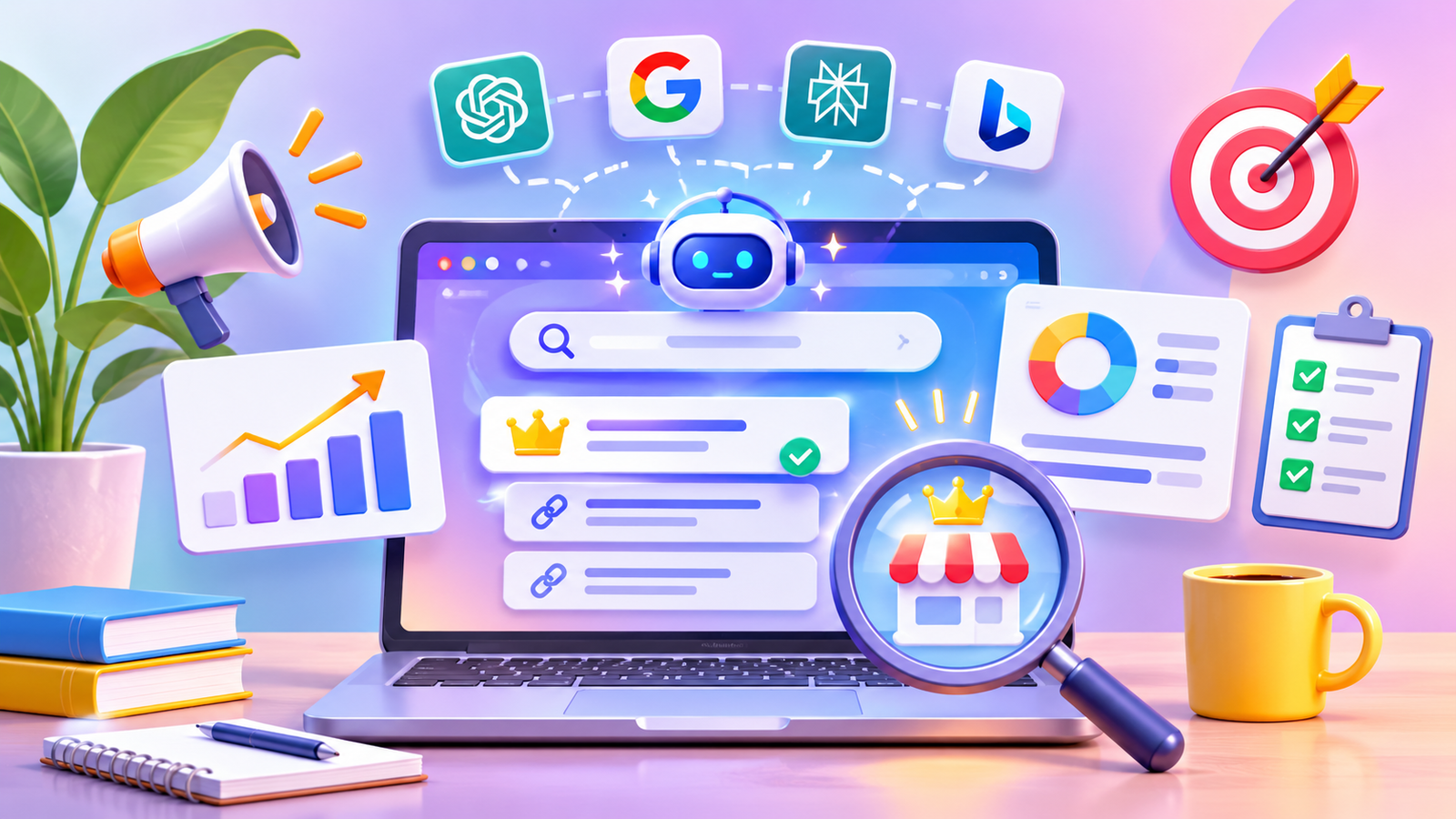
How to track your brand visibility in AI search results is becoming an important question for businesses that want to stay visible as people use AI tools to find information, compare products, and discover services. Traditional SEO focuses on search rankings, clicks, and website traffic. AI search adds another layer because your brand may be mentioned in an answer even when users never visit your website.
Tools such as ChatGPT Search, Google AI Overviews, and Perplexity can present information directly to users. This changes how businesses need to measure online visibility. Instead of checking only where a website ranks on Google, marketers should also monitor when AI tools mention their brand, which sources they reference, and whether those mentions lead to meaningful website visits.
In this guide, you will learn how to track brand visibility in AI search results, which metrics matter, and how to build a simple monitoring process.
What Is Brand Visibility in AI Search?
Brand visibility in AI search refers to how often and in what context your business appears in answers generated by AI-powered search tools.
For example, someone might ask an AI tool to recommend the best email marketing platforms for small businesses. The answer may mention several brands, compare their features, and link to supporting websites.
If your brand appears in that answer, it has gained visibility even if the user does not immediately click through to your website.
AI search visibility can include:
- Brand mentions in AI-generated answers
- Links or citations pointing to your website
- Recommendations for specific products or services
- Inclusion in AI-generated comparisons and lists
- Website visits from AI-powered platforms
- Leads or sales influenced by AI search discovery
These signals help you understand whether your business is becoming easier to discover through AI-powered search experiences.
1. Test Your Brand Across Different AI Search Platforms
The first step is to check whether AI tools mention your brand when users ask relevant questions.
Do not rely on a single platform. Different AI tools may generate different answers, use different sources, and mention different businesses.
Start by testing platforms such as:
- ChatGPT Search
- Google AI Overviews
- Perplexity
- Microsoft Copilot
Create a list of questions that potential customers might ask before choosing a product or service.
For example, if you run a digital marketing agency, test questions such as:
- Which digital marketing agencies help small businesses?
- What should I look for when hiring an SEO agency?
- Which companies offer affordable website development?
- What are the best SEO services for a local business?
Record whether your brand appears, where it appears in the answer, and whether the platform provides a link to your website.
Important: AI answers can change between searches, locations, accounts, and dates. A single result is not enough to establish your overall visibility. Repeat the same tests over time and record your observations.
2. Build a List of Important Search Prompts
Checking random questions will not give you a reliable picture of your brand’s AI visibility. You need a consistent set of prompts related to your business.
Organise your prompts into different categories.
Informational prompts: Questions people ask while learning about a topic.
Example: “How can a small business improve its online presence?”
Comparison prompts: Questions that compare different solutions.
Example: “What is the difference between hiring an SEO agency and an in-house SEO specialist?”
Recommendation prompts: Questions asking AI to suggest businesses, tools, or services.
Example: “Recommend affordable website design services for a small business.”
Brand-specific prompts: Questions directly about your business.
Example: “What services does [Your Brand Name] offer?”
Use approximately 20–50 relevant prompts as a starting point if your resources allow. Smaller businesses can begin with 10–15 and expand the list later.
Keep your prompts consistent from one tracking period to the next. This makes it easier to identify changes instead of confusing them with differences in the questions.
3. Track Brand Mentions and Citations Separately
A brand mention and a website citation are not the same thing.
A brand mention happens when an AI answer names your business. A citation occurs when the platform provides a source link supporting its answer. A citation may point to your website, a review platform, a directory, or another publisher.
Track these signals separately because each tells you something different.
For example:
- Your brand is mentioned and your website is cited: Users can discover your name and access your website.
- Your brand is mentioned without a citation: The business has visibility, but the answer may not provide a direct route to your site.
- Your website is cited without a clear brand mention: Your content may be supporting the answer even if your business name is not prominent.
- A competitor is recommended instead: You may need to investigate differences in relevance, content quality, reputation, or available information.
Do not assume that a citation automatically means a positive recommendation. Review the surrounding answer to understand how your business is presented.
4. Use a Spreadsheet to Record AI Visibility
You do not need expensive software to start tracking your brand. A simple spreadsheet can help you establish a baseline and monitor changes.
Create columns for the platform, prompt, date checked, brand mention, website citation, competitor mentions, answer context, and notes.
A basic tracking table might look like this:
| Platform | Prompt | Brand mentioned? | Website cited? |
|---|---|---|---|
| ChatGPT Search | Best tools for small businesses | Yes | Yes |
| Perplexity | Affordable SEO services | No | No |
| Google AI Overviews | How to improve local SEO | Yes | No |
These are example entries, not actual search results.
Update the spreadsheet weekly or monthly, depending on your needs. Keep copies of important answers or record their URLs when possible so you can review how the results change.
For larger businesses, dedicated AI search visibility platforms may automate parts of this process. However, manually checking a small, well-selected prompt list is a reasonable way to begin.
5. Measure the Right AI Search Visibility Metrics
Tracking mentions alone does not explain whether your visibility is improving. You should measure several indicators together.
Brand Mention Rate
This measures how frequently your brand appears across the prompts you monitor.
Formula:
Brand Mention Rate = (Prompts where your brand appears ÷ Total prompts checked) × 100
For example, if your brand appears in 12 out of 30 prompts:
(12 ÷ 30) × 100 = 40%
Your brand mention rate is 40% for that particular tracking set.
Citation Rate
Citation rate measures how often your website is linked as a source in the answers you monitor.
Use the same calculation, replacing brand mentions with website citations.
Keep the denominator consistent. For example, decide whether you are measuring citations across all prompts or only prompts where an AI answer was generated.
Competitor Visibility
Check how frequently competitors appear in the same answers. This helps you understand whether other businesses are more visible for particular topics or customer questions.
Avoid relying only on a single overall competitor score. Compare visibility by topic, service, and platform to find specific gaps.
AI Referral Traffic
This measures visits arriving at your website from AI platforms.
You can review referral traffic in analytics tools such as Google Analytics 4. Depending on how visits are attributed, some AI-assisted journeys may not appear as identifiable referrals.
Conversions and Leads
Traffic is useful, but it is not the final business goal. Track enquiries, demo requests, purchases, sign-ups, and other conversions associated with AI referral traffic where your analytics setup supports it.
Together, these metrics provide a clearer view of visibility and business impact.
6. Track AI Referral Traffic in Google Analytics 4
AI search visibility does not always generate a direct website visit. However, referral traffic can show when someone clicks through from an AI platform to your website.
To review this data in Google Analytics 4:
- Open your GA4 property.
- Go to Reports and open the traffic acquisition report.
- Review the session source and medium dimensions.
- Look for identifiable AI platform referrals, such as visits from Perplexity or ChatGPT-related domains.
- Compare sessions, engagement, and conversions over time.
The exact source names depend on the referral information collected by your analytics setup. Check your traffic source details rather than assuming every AI visit will appear under one universal label.
You can also create a custom exploration to compare identifiable AI referrals with other acquisition channels.
Remember that referral traffic is only one part of the picture. Someone may discover your brand through an AI answer, remember its name, and visit your website later through a direct visit or branded Google search.
7. Monitor Brand Visibility Without Relying on Rankings
Traditional SEO reports often focus on keyword positions, impressions, clicks, and organic traffic. These metrics remain useful, but they do not fully explain your presence in AI-generated answers.
A page may receive AI citations without ranking first for a traditional search query. Similarly, a website may have strong Google rankings but rarely appear in AI recommendations.
Use a combined measurement approach:
- SEO: Organic rankings, impressions, clicks, and organic traffic.
- AEO: The extent to which content answers users’ questions clearly and directly.
- GEO: Visibility and representation within generative AI search experiences.
- Business performance: Leads, enquiries, purchases, and other meaningful conversions.
These areas overlap, but they measure different aspects of online discovery. No single metric provides a complete picture of your brand’s performance.
8. Find Out Why Competitors Appear More Often
If competing brands appear more frequently in AI answers, investigate the prompts where the gap occurs.
Check whether competitors have:
- More detailed pages covering the exact question
- Clear explanations of their products or services
- Useful comparisons and original research
- Strong customer reviews and consistent business information
- Relevant mentions on trusted third-party websites
- Accurate, crawlable pages with accessible content
Do not assume that adding more keywords or publishing large numbers of articles will automatically improve AI visibility.
Instead, identify the questions where your business is missing and create genuinely useful content that addresses the needs behind those questions. Make sure your claims are accurate and supported by evidence.
9. Create a Monthly AI Visibility Report
A monthly report turns individual observations into a useful marketing process.
Include the following sections:
Visibility overview: How many prompts were checked and how frequently your brand appeared.
Citation performance: How often your website was linked as a source.
Competitor comparison: Which competitors appeared most often and for which topics.
Traffic and conversions: Identifiable AI referrals, engaged sessions, and measurable business results.
Content opportunities: Questions where your brand was missing or competitors provided more useful information.
Next steps: Specific content updates, technical improvements, or reputation-building activities to prioritise.
Compare results with your previous tracking period. Look for consistent changes rather than reacting to a single unusual AI answer.
Common Mistakes to Avoid When Tracking AI Search Visibility
Avoid these common measurement mistakes:
- Checking only one AI platform.
- Testing different prompts every time and comparing the results as if they were identical.
- Counting every brand mention as a positive recommendation.
- Treating citations and brand mentions as the same metric.
- Assuming all AI-influenced visitors will appear as referral traffic.
- Focusing on visibility without checking leads or sales.
- Using unverified AI visibility scores as proof of business growth.
AI-generated answers are dynamic, so tracking should focus on patterns, context, and measurable outcomes rather than isolated results.
Frequently Asked Questions
How can I check if my brand appears in AI search results?
Search for your brand using relevant questions in platforms such as ChatGPT Search, Google AI Overviews, and Perplexity. Record brand mentions, website citations, competitors, and the date of each check.
Which tools can track AI search visibility?
You can begin with a spreadsheet and manual checks. Analytics platforms such as Google Analytics 4 can help identify some AI referral traffic, while specialised AI visibility tools may offer prompt monitoring, citation tracking, and competitor comparisons. Features and coverage vary by provider.
How often should I track AI search results?
Weekly tracking can be useful for active campaigns, while monthly monitoring may be sufficient for smaller websites. Consistency matters more than checking constantly.
Does appearing in AI answers improve SEO rankings?
Not necessarily. Appearing in AI-generated answers and ranking in traditional search results are different outcomes. Useful content and sound technical SEO can support discoverability, but AI mentions do not guarantee higher rankings.
Can a small business improve its AI search visibility?
Yes. Start by answering customers’ questions clearly, publishing accurate and useful content, maintaining consistent business information, improving website accessibility to search crawlers, and building a credible online reputation. Then measure whether these efforts improve visibility over time.
Final Thoughts
Tracking brand visibility in AI search results requires more than checking whether your business name appears in an answer. You need to understand how often it appears, which sources support those answers, how competitors compare, and whether AI-driven discovery contributes to meaningful business results.
Start with a small set of customer-focused prompts, record the results consistently, and review the data every month. Combine AI visibility monitoring with traditional SEO analytics and conversion tracking to make better marketing decisions.
As AI-powered search continues to develop, businesses that measure their visibility carefully will be better prepared to identify opportunities, improve their content, and understand how customers discover their brands online.