




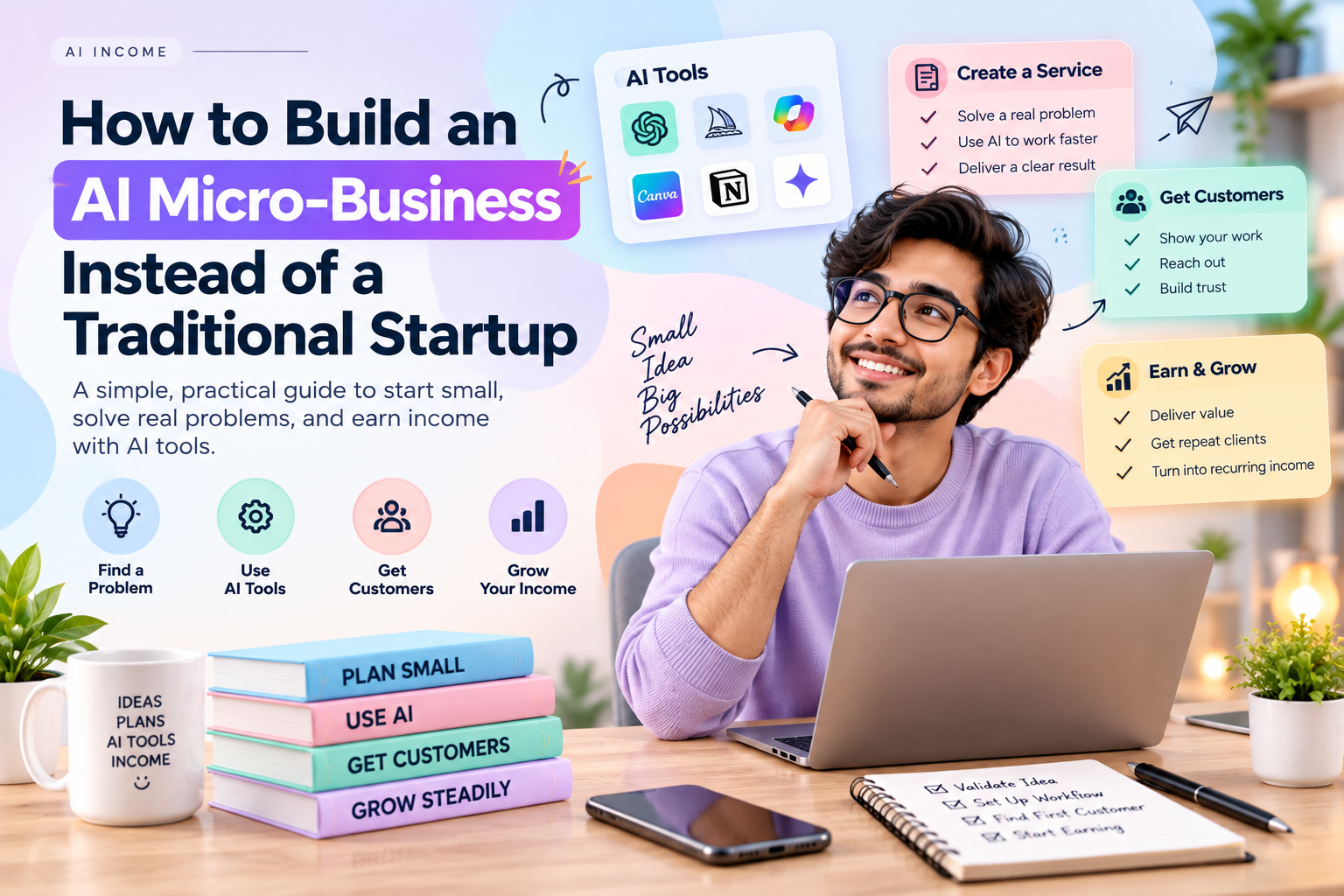
An AI Micro-Business can be a simple way to turn one useful skill, service, or automated process into an online income stream without building a traditional startup from day one. Instead of hiring a large team, renting an office, developing an expensive product, and trying to serve thousands of customers, you can start with one specific problem and use AI tools to handle parts of the work.
The idea is not to build the next huge technology company immediately.
It is to build something small that solves a real problem and can generate revenue.
AI can help with research, content creation, customer communication, design, data processing, automation, and many other repetitive tasks. This allows one person to handle work that might previously have required several tools or people.
But AI alone does not create a business.
You still need a useful offer, customers, a way to deliver the result, and a reason for people to pay you.
What Is an AI Micro-Business?
An AI micro-business is a small business that uses artificial intelligence to deliver a specific product or service, automate repetitive work, or operate more efficiently.
It can be run by one person or a very small team.
Examples include:
- AI content services
- AI-powered research
- AI chatbot setup
- AI workflow automation
- AI-assisted design services
- AI social media services
- AI video creation
- AI data analysis
- AI-powered lead research
- AI consulting
- AI digital products
The important part is the micro aspect.
You do not need to start with ten services.
You can start with one problem and one solution.
AI Micro-Business vs Traditional Startup
A traditional startup often aims to build a larger company from the beginning.
It may require:
- A team
- Significant funding
- Product development
- Office infrastructure
- Multiple departments
- Larger marketing budgets
- Complex operations
An AI micro-business can start much smaller.
You might need:
- One skill
- One useful AI tool
- A simple website or portfolio
- A way to receive payments
- A small number of customers
This does not mean every AI micro-business will remain small.
Some can grow into larger businesses.
The advantage is that you can test the idea before making a major investment.
1. Start With a Problem, Not an AI Tool
One of the biggest mistakes beginners make is starting with a tool.
They discover an impressive AI application and immediately think:
“How can I make money from this?”
Reverse the process.
Start by asking:
“What problem are people already willing to pay to solve?”
For example:
A small business may struggle to create social media content.
A real estate agent may need property descriptions.
A local business may need customer enquiry automation.
An online store may need product descriptions.
A consultant may need research reports.
A company may spend hours organising information manually.
These are problems.
AI is simply one possible way to solve them.
2. Choose One Narrow Market
You do not need to sell your service to everyone.
In fact, being specific can make marketing easier.
Instead of:
“I provide AI services.”
try:
“I create AI-assisted social media content for local restaurants.”
Or:
“I build simple AI customer-support systems for small online stores.”
Or:
“I create AI-powered property descriptions for real estate agents.”
A narrow market makes it easier to understand:
- What customers need
- Where to find them
- What problems they face
- What language they use
- What they might pay for
3. Pick a Service That Produces a Clear Result
People usually do not want AI.
They want an outcome.
A business owner does not necessarily want:
“AI automation.”
They may want:
“Fewer hours spent answering repetitive customer questions.”
A marketer may not want:
“AI content generation.”
They may want:
“A month of social media posts prepared faster.”
A better offer focuses on the result.
Think:
Problem ? Process ? Result
For example:
Problem: A business spends hours writing social media posts.
Process: Use AI-assisted research, writing, editing, and scheduling.
Result: A ready-to-publish monthly content package.
4. Use AI to Reduce the Workload
Once you have identified the service, look for repetitive tasks.
For example, a content service may involve:
- Research
- Topic selection
- Outline creation
- First draft
- Editing
- Formatting
- Image creation
- Scheduling
- Reporting
AI can assist with several parts of this workflow.
But do not automate everything blindly.
Human review is important when accuracy, brand voice, originality, or customer requirements matter.
The goal is to make your process faster, not careless.
5. Build a Simple Workflow
A micro-business becomes easier to manage when the work follows a repeatable process.
For example:
Customer submits requirements
?
AI-assisted research
?
Content or solution creation
?
Human review
?
Final delivery
?
Customer feedback
?
Improved workflow
Once you have a repeatable process, you do not have to reinvent your work for every customer.
6. Create a Simple Offer
Do not launch with twenty packages.
Start with one clear offer.
For example:
AI Social Media Starter Package
Includes:
- 12 social media posts
- Caption writing
- Content ideas
- AI-assisted visuals
- Basic content calendar
Or:
AI Business Research Package
Includes:
- Competitor research
- Market information
- Customer insights
- Summary report
- Action points
A simple offer makes it easier for customers to understand what they are buying.
7. Build a Small Portfolio
You do not always need previous customers to create a portfolio.
You can create sample projects.
For example, if you want to offer AI-assisted social media services to restaurants, choose a fictional restaurant and create:
- Five social posts
- Three ad concepts
- A content calendar
- A promotional campaign
Clearly label them as sample work.
This gives potential customers something concrete to evaluate.
8. Find Your First Customers
Your first customers may come from places where your target audience already spends time.
Depending on your business, this could include:
- Facebook groups
- Freelance platforms
- Local business networks
- Industry communities
- Personal connections
- Cold outreach
- Your own website
- Social media
Avoid sending generic messages to hundreds of businesses.
Research the business first.
Then identify a genuine problem you can help solve.
A personalised message can be much more useful than:
“Hello, I offer AI services. Are you interested?”
9. Sell the Outcome, Not the Technology
This is one of the most important ideas for an AI micro-business.
Customers may not care which AI model or software you use.
They care about the result.
Instead of saying:
“We use advanced AI technology.”
say:
“We help small businesses prepare a month of social media content without spending hours writing every post.”
The second message communicates value much more clearly.
10. Keep Your Costs Low
One reason to start small is to avoid unnecessary expenses.
You may need:
- AI software
- Website hosting
- Domain
- Design tools
- Payment processing
- Communication tools
- Automation software
But you do not need every tool available.
Start with the smallest practical technology stack.
Only add another subscription when it solves a real business problem.
11. Automate Repetitive Administration
Once you have customers, administrative work can consume a surprising amount of time.
AI and automation can help with tasks such as:
- Organising enquiries
- Creating meeting summaries
- Drafting emails
- Preparing reports
- Sorting information
- Creating task lists
- Generating basic documents
- Organising customer requests
This allows you to spend more time on work that actually creates value.
12. Create Recurring Revenue
One-off projects can generate income, but recurring services can create more predictable revenue.
For example:
Monthly AI Content Service
Monthly AI Reporting
AI Customer Support Management
Monthly Lead Research
AI Automation Maintenance
Monthly Content Repurposing
Instead of constantly finding new customers, you can continue serving existing customers.
The exact pricing depends on the service, market, workload, and value delivered.
13. Create a Subscription-Style Offer
A recurring offer can be structured around a clear monthly deliverable.
For example:
Basic
10 content pieces per month.
Standard
20 content pieces plus visual assets.
Premium
30 content pieces, visuals, scheduling, and monthly reporting.
The exact structure should depend on your audience.
Do not add features simply to make a package look bigger.
Each feature should solve a customer problem.
14. Protect the Quality of Your Work
AI can produce output quickly.
Fast does not automatically mean good.
Before delivering AI-assisted work, check:
- Accuracy
- Grammar
- Facts
- Originality
- Brand tone
- Formatting
- Privacy
- Copyright considerations
- Customer requirements
Your customer is paying for the final result, not for how quickly an AI tool generated a draft.
15. Be Careful With Sensitive Customer Data
If your business uses AI tools to process customer information, understand what information you are handling and what your chosen tools allow.
Avoid casually uploading sensitive information such as:
- Passwords
- Financial information
- Private customer records
- Confidential business documents
- Personal identification information
Create a simple process for handling customer data safely.
Your AI business should not create unnecessary privacy risks.
16. Create Standard Operating Procedures
Once your workflow works, document it.
Write down:
- How customers submit information
- Which tools you use
- What prompts or templates are useful
- How you review AI output
- How files are organised
- How projects are delivered
- How revisions are handled
This becomes your internal operating system.
Later, if you hire someone or expand the business, these documents can make training much easier.
17. Track Your Time
Do not assume that an AI-powered service is profitable just because AI makes it faster.
Track:
Time spent
Software costs
Customer acquisition costs
Revenue
Revision time
Support time
For example, if you charge ?5,000 for a service but spend ten hours completing it, you need to know whether that model makes sense after your other costs.
Efficiency should improve your margins, not simply allow you to take on more work.
18. Improve the Offer Using Customer Feedback
Your first version does not need to be perfect.
Talk to customers.
Ask:
- What was most useful?
- What was confusing?
- What took too long?
- What would you like included?
- What would make the service more valuable?
Then improve the offer.
A small business can change its service much faster than a large organisation with complex processes.
19. Turn Repeated Work Into a Product
You may eventually discover that customers repeatedly ask for the same thing.
That is an opportunity.
For example, if you repeatedly create:
- Content calendars
- Marketing templates
- Research reports
- Business prompts
- AI workflows
- Social media templates
you could turn some of that work into a digital product.
You might sell:
- Templates
- Prompt packs
- Guides
- Checklists
- Courses
- Toolkits
- Notion systems
- Spreadsheet systems
This can create an additional revenue stream from work you have already learned to produce.
20. Build a Brand Around the Problem You Solve
Do not make your entire brand about a specific AI tool.
Tools can change.
Your customers’ problems may remain.
For example, instead of building a brand around:
“XYZ AI Tool Experts”
you could position yourself around:
“Helping small businesses automate repetitive marketing tasks.”
This gives your business room to adapt when new AI tools appear.
Common Mistakes to Avoid
Trying to Serve Everyone
A broad offer can make your business difficult to understand.
Buying Too Many Tools
More subscriptions do not automatically create more revenue.
Selling AI Instead of Results
Customers want solutions, not complicated technology.
Over-Automating
Some tasks need human judgement and quality control.
Ignoring Customer Service
AI can help with operations, but customers still value communication and reliability.
Copying Existing AI Businesses
Find your own audience, problem, or approach rather than simply copying another business.
Expecting Instant Income
Building a profitable business still takes testing, marketing, customer service, and persistence.
A Simple 30-Day AI Micro-Business Plan
You can use a simple four-week approach.
Week 1 — Find the Opportunity
Choose:
- One market
- One problem
- One service
- One clear result
Talk to potential customers and understand what they actually need.
Week 2 — Build the Service
Create your workflow.
Choose the minimum tools required.
Create sample work.
Document your process.
Week 3 — Start Marketing
Build a simple landing page or portfolio.
Publish useful content.
Reach out to potential customers.
Share your sample work.
Collect feedback.
Week 4 — Improve and Sell
Refine your offer based on feedback.
Start charging for the service.
Track your time and expenses.
Look for ways to make delivery faster without reducing quality.
AI Micro-Business Ideas You Can Start
Here are some practical directions to explore:
| AI Micro-Business | Potential Customer |
|---|---|
| AI Social Media Service | Small businesses |
| AI Content Repurposing | Creators and brands |
| AI Research Service | Consultants and agencies |
| AI Chatbot Setup | Local businesses |
| AI Workflow Automation | Small companies |
| AI Video Creation | Content creators |
| AI Product Description Service | Online stores |
| AI Lead Research | Sales teams |
| AI Presentation Service | Businesses |
| AI Digital Products | Online audiences |
These are business models to explore, not guaranteed income opportunities. Demand, competition, pricing, and required skills vary by market.
Final Thoughts
Building an AI Micro-Business does not require you to begin with a huge team, expensive office, or complicated product.
Start smaller.
Find one problem.
Choose one audience.
Create one useful solution.
Use AI to make the delivery process faster and more efficient.
Then test the offer with real customers.
If people find the service valuable, improve it and gradually build systems around it.
The biggest opportunity may not be creating a business that simply uses AI.
It may be creating a business that uses AI to solve a problem people already have.
That difference can help you build something practical instead of chasing every new AI trend.
Frequently Asked Questions
What is an AI micro-business?
An AI micro-business is a small business that uses AI tools to provide a specific service, product, or solution. It can often be operated by one person or a small team.
Can I start an AI micro-business alone?
Yes. Many AI-based services can be started by one person, particularly when the business focuses on a narrow service and uses AI to reduce repetitive work.
How much money do I need to start?
The cost depends on the business model. A simple service business may require only basic software, a website or portfolio, and a way to communicate with customers and receive payments.
What is the best AI micro-business to start?
There is no single best option for everyone. Look for a problem you understand, a customer group you can reach, and a service where AI can help you deliver a useful result efficiently.
Can an AI micro-business become a full company?
Yes. A micro-business can potentially grow by adding customers, recurring services, employees, automation, or digital products. Starting small allows you to test the business before expanding.
Do I need advanced AI skills?
Not necessarily. Many AI micro-businesses can start with practical knowledge of existing AI tools. However, you should understand the tools you use and be able to review their output properly.
Is an AI micro-business passive income?
Usually not at the beginning. Most service-based AI businesses require active work. Over time, automation, recurring services, templates, and digital products can reduce the amount of manual work involved.