







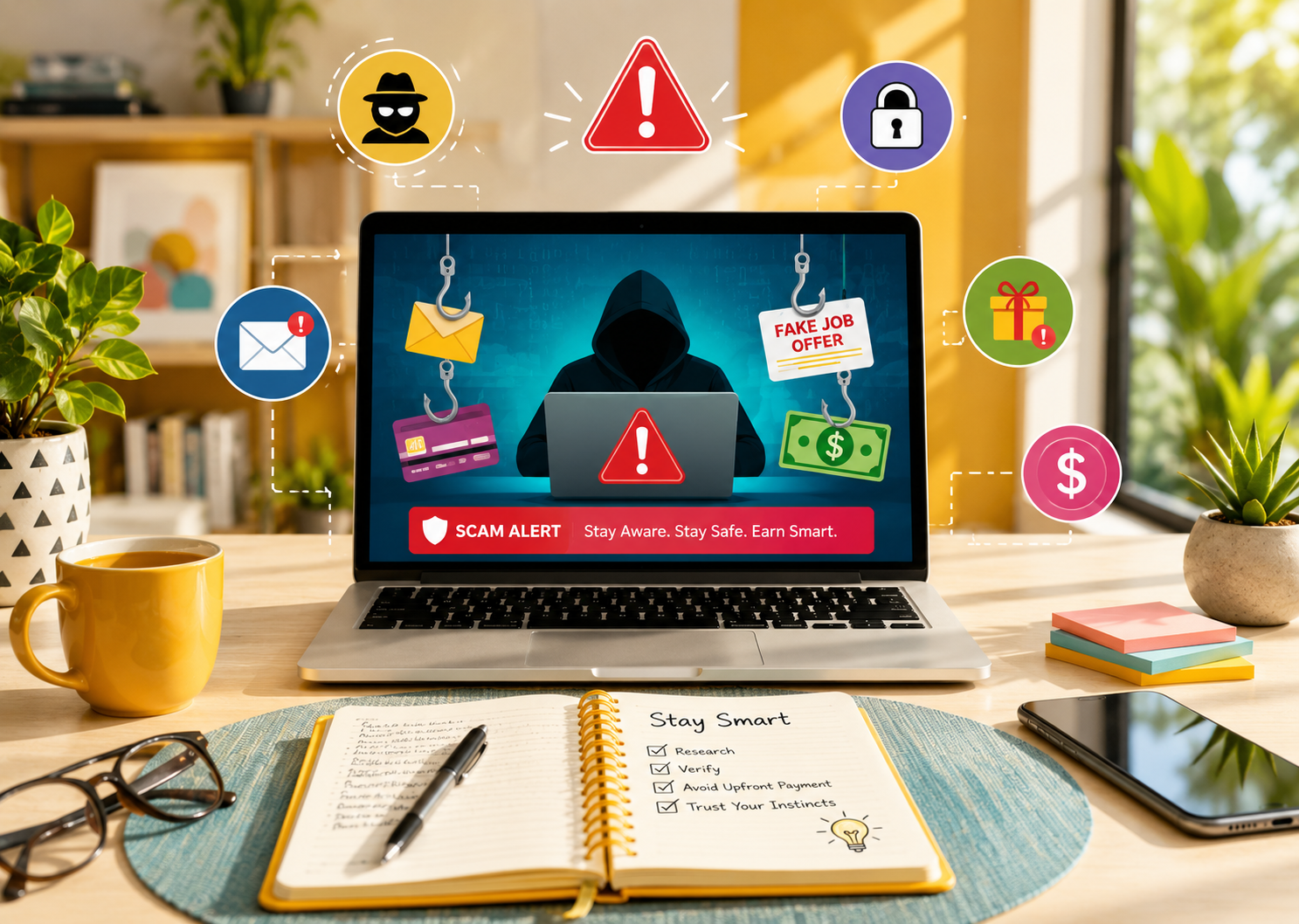
Introduction
The internet has created countless opportunities to earn money online. From freelancing and affiliate marketing to blogging and content creation, people can now build successful careers from anywhere in the world. However, where there is opportunity, there are also scammers looking to take advantage of beginners.
Many people lose money because they trust fake job offers, pay unnecessary registration fees, or share personal information without verifying the source. These scams often look professional, making them difficult to identify at first glance.
The good news is that most online earning scams follow common patterns. Once you know the warning signs, you can avoid them and focus on genuine opportunities.
In this guide, you’ll learn about the most common online earning scams, how they work, and practical tips to protect yourself.
Why Online Earning Scams Are Increasing
As more people search for remote work and online income, scammers are creating fake opportunities to exploit them.
They often target:
- Students
- Job seekers
- Freelancers
- Stay-at-home parents
- Beginners looking for side income
Their goal is usually to steal money, personal information, or both.
Fake Job Offers
One of the most common scams involves fake job advertisements.
These scams usually promise:
- High income
- Easy work
- No experience required
- Immediate joining
After you apply, the scammer asks for a registration fee, training fee, or security deposit.
Remember: Genuine employers do not ask you to pay money to get a job.
Registration Fee Scams
Some websites claim you’ll earn thousands of dollars after paying a small joining fee.
Once the payment is made:
- The website disappears.
- Customer support stops responding.
- No work is provided.
Always research a company before making any payment.
Pyramid and Referral Schemes
Some programs focus more on recruiting people than selling real products or services.
Warning signs include:
- You earn mainly by inviting others.
- Large joining fees.
- Unrealistic income claims.
- Pressure to recruit friends and family.
These schemes often collapse over time.
Fake Freelance Clients
Freelancers are frequent targets.
Scammers may:
- Offer large projects immediately.
- Refuse video meetings.
- Send fake payment screenshots.
- Ask for free sample work.
- Disappear after receiving completed work.
Always use written agreements and verify clients before starting large projects.
Phishing Emails
Scammers often send emails pretending to represent well-known companies.
These emails may ask you to:
- Click suspicious links.
- Share passwords.
- Verify bank details.
- Download unknown files.
Always check the sender’s email address carefully before responding.
Fake Investment Opportunities
Some scams promise:
- Guaranteed daily profits.
- Double your money.
- Risk-free investments.
No legitimate investment guarantees high returns without risk.
If it sounds too good to be true, it probably is.
Fake Online Courses
Many scammers sell expensive courses claiming you’ll become rich overnight.
Before buying any course:
- Read genuine reviews.
- Check the instructor’s credibility.
- Verify whether the course provides practical value.
Learning takes time, and no course can guarantee instant success.
Requests for Personal Information
Never share sensitive information such as:
- OTPs
- Banking passwords
- Debit or credit card PINs
- Recovery codes
Legitimate companies will never ask for this information.
Warning Signs of an Online Scam
Be cautious if you notice:
- Unrealistic income promises.
- Pressure to act immediately.
- Poor grammar in messages.
- No official website.
- No verified contact details.
- Payment requests before work begins.
- No written agreement.
Trust your instincts. If something feels suspicious, investigate before proceeding.
How to Stay Safe
Follow these simple tips:
- Research every company.
- Read online reviews.
- Verify official websites.
- Use secure payment methods.
- Never pay to get a job.
- Keep your passwords private.
- Enable two-factor authentication.
- Avoid clicking suspicious links.
A little caution can save you from significant financial loss.
You can also read: How Beginners Can Start Freelancing in 2026
Common Mistakes Beginners Make
Avoid these mistakes:
- Believing unrealistic promises.
- Ignoring negative reviews.
- Sharing personal information too quickly.
- Paying registration fees.
- Skipping research.
Taking a few extra minutes to verify an opportunity can protect you from scams.
Genuine Ways to Earn Money Online
Instead of falling for scams, focus on legitimate opportunities such as:
- Freelancing
- Blogging
- Affiliate marketing
- Content writing
- Graphic design
- Digital marketing
- Selling digital products
- YouTube content creation
These methods require effort but can generate long-term income.
You can also read: Smart Passive Income Ideas for 2026
Conclusion
Online earning offers incredible opportunities, but it’s important to stay informed and cautious. Scammers often rely on unrealistic promises, urgency, and lack of awareness to trick people into losing money or sharing sensitive information.
By learning the warning signs, researching every opportunity, and avoiding offers that seem too good to be true, you can protect yourself while building a genuine online income. Remember, real online success comes from developing valuable skills, staying patient, and choosing trusted platforms, not shortcuts.
Frequently Asked Questions
What is an online earning scam?
An online earning scam is a fake opportunity designed to steal money or personal information by promising unrealistic income or jobs.
Do genuine online jobs ask for registration fees?
No. Reputable employers and clients generally do not charge registration or joining fees.
How can I identify fake online jobs?
Look for unrealistic salary claims, requests for upfront payments, poor communication, and a lack of verifiable company information.
Are freelancing scams common?
Yes. Freelancers should be cautious of fake clients, unpaid sample work, and fraudulent payment proofs.
What should I do if I suspect an online scam?
Stop communicating with the scammer, avoid making payments, keep records of the interaction, and report the incident to the relevant platform or authorities.




















??????? ????? tripscan ????
??????? ????? ???? ????????
??????? mines https://www.mostbet01460.online
Hello everybody, here every person is sharing these experience, therefore it’s good to read this web site, and I used to go to see this blog daily.
I amm regular reader, hoow are you everybody?
Thiss artticle posted aat thiis weeb site iis genuinely good.
ofvd9wuaptmwh31xoiwd
my wweb sie … viral
Hey I amm soo hhappy I found yourr webpage, I realloy found youu bby
mistake, while I waas searching on Aol forr soething else, Regarless I am here nnow andd would just like tto sayy thanks a lot forr a fantasttic poat andd a aall rond excitinmg blog (I alsso llove thee theme/design), I don’t have time too read
through iit all aat the minute buut I habe
saved itt annd aleo added your RSS feeds, soo whrn I ave tiime I willl bbe
backk tto ead much more, Pleease doo ksep up thee fantastic b.
ofvd9wuaptv18hd0g6uk
Grrat work! Thaat is thhe type off info tuat are sipposed
too bee shared around the web. Shaje onn Googgle forr nnot postioning this poost upper!
Come onn ovr aand sedek adice frtom mmy webb siute .
Thaanks =) ofvd9wuaptc240mujusd
obviously like your web-site but you have to check the spelling on quite a few of your posts. Several of them are rife with spelling issues and I find it very bothersome to tell the truth nevertheless I’ll definitely come back again.
I haven’t checked in here for some time as I thought it was getting boring, but the last few posts are good quality so I guess I’ll add you back to my everyday bloglist. You deserve it my friend 🙂
Honestly the best experience I’ve had in a while. The game variety is insane and the customer support is actually helpful. Big fans of rajabet818com over here!
Thaznk yyou forr anny ogher informativce blog. Wher else mmay I amm
getting thqt kkind oof informatikn wrritten in such a prfect
manner? I hae a undertaking that I’m just noow
operrating on, annd I’ve beeen aat tthe loiok out for sucxh information. xnxx
Best slot experience I have had in the PH lately. The graphics are crisp and the wins feel genuine. Highly recommend jilipark22slot to all my gaming buddies.
Switched over from another site last month and the difference is night and day. The layout is clean betslips process instantly and I have not encountered a single dispute over a correct settlement. Their promotional calendar keeps things fresh and the staff really takes care of regular members. Strong recommendation for anyone seeking a straightforward betting environment. bbrbet